Meet the Robinson’s Family Movie Night, with a Side Dish of Therapy
Family Dinner and a Movie, Meet the Robinsons
Keep Moving Forward: A Family Movie Night About Mistakes, Belonging and Trying Again
Some children treat mistakes like mildly inconvenient speed bumps. Other children experience one wrong answer, missed goal or misunderstood instruction as evidence that the entire day, and possibly their entire future, is ruined.
They erase holes through their homework. They refuse to try something unless they already know they can succeed. They melt down when a drawing does not match the picture in their head. They procrastinate, avoid, control or announce that something is “stupid” before anyone can discover they are afraid they cannot do it.
That is why this month’s Family Dinner and a Movie—with a Side Dish of Therapy features Meet the Robinsons.
It is colorful, wonderfully strange and full of people who understand that failure is not the opposite of success. Sometimes failure is where the next part of the story begins.
Our theme for the night is:
Keep moving forward—without shaming the moments when moving forward feels hard.
No forced family meeting. No secretly analyzing your child between bites of pasta. Just an easy dinner, a fizzy drink, a gloriously imperfect dessert and a few playful opportunities to connect.

Tonight’s Menu 🚀
Main Course: Keep Moving Forward Pizza Pasta
This easy pasta bake combines the comfort of pizza with a dinner that does not require anyone to invent a time machine before 6:00 p.m.
Ingredients
1 pound rotini or bow-tie pasta
1 pound ground Italian sausage or ground beef
1 jar marinara sauce
1 teaspoon Italian seasoning
2 cups shredded mozzarella cheese
½ cup mini pepperoni
¼ cup grated Parmesan cheese
Optional additions: diced bell peppers, mushrooms, black olives or spinach
Directions
Heat the oven to 375°F.
Cook the pasta until just tender. Drain it and return it to the pot.
Brown the sausage or ground beef in a skillet and drain any excess grease.
Stir the meat, marinara sauce, Italian seasoning, half of the mozzarella and any optional vegetables into the pasta.
Transfer everything to a greased 9-by-13-inch baking dish.
Top with the remaining mozzarella, pepperoni and Parmesan.
Bake for 20–25 minutes, until the cheese is melted and bubbly.
Serve it with a bagged salad or garlic bread if your family would like a side. (Store-bought absolutely counts! We are building connection, not auditioning for a cooking show.)
Mocktail: Todayland Tomorrow Fizz ✨
This bright, sparkly drink feels a little futuristic without requiring laboratory equipment.
For each drink
2 ounces white grape juice
2 ounces lemonade
3–4 ounces elderflower tonic or lemon-lime sparkling water
A few blueberries
A squeeze of fresh lime
Edible shimmer dust or colorful sanding sugar, optional
Directions
Add blueberries to a clear glass and gently press a few with the back of a spoon.
Fill the glass with ice.
Add the white grape juice and lemonade.
Top with elderflower tonic or sparkling water.
Add a squeeze of lime and stir.
Finish with a tiny pinch of edible shimmer dust if you want a time-machine-worthy sparkle.
For younger children or anyone sensitive to carbonation, replace the tonic with cold white grape juice or just lemonade.
Dessert: Perfectly Imperfect Brownie Sundaes 🍨
The assignment is simple: make a dessert that is delicious without trying to make it perfect.
You will need
Store-bought or homemade brownies
Vanilla or chocolate ice cream
Whipped cream
Chocolate or caramel sauce
Sprinkles
Chopped cookies, berries or candy
Cherries, optional
Break the brownies into uneven pieces and let everyone build a sundae.
Yes, break them on purpose.
The crooked pieces, crumbly corners and scoop that refuses to look round are all welcome. This dessert does not need to be picture-perfect to be wonderful—and neither does your family.

The Side Dish of Therapy: The Failed Invention Challenge 🛠️
Before the movie, give everyone a few simple supplies:
Paper
Tape
Plastic cups
Craft sticks
Straws
Pipe cleaners
Aluminum foil
Blocks or LEGO bricks
Any clean recyclables you already have
Invite each person to invent something that would make family life easier, funnier or slightly more ridiculous.
Ideas might include:
A machine that finds missing shoes
A homework-completing robot
A sibling-volume controller
A backpack that packs itself
A device that translates teenage sighs
A machine that alerts everyone when the dog is about to steal dinner
Set a timer for 10 minutes. The invention does not need to work.
In fact, failure is encouraged.
Afterward, let each person share:
What was the invention supposed to do?
What went differently than expected?
What would you change next time?
Did anything surprising happen because it did not work?
The goal is not to convince a distressed child that mistakes are “no big deal.” To them, the mistake may feel enormous.
Instead, the activity helps the family practice discovering that something can go wrong without the connection, curiosity or fun disappearing with it.
Conversation Starters for the Movie 🎬
Choose only the questions that fit your family. You do not need to ask all of them, and your child is always allowed to pass.
Light and Playful Questions
Which Robinson family invention would you most like to try?
Which character would be the most entertaining dinner guest?
What would your own time machine look like?
If Stitch joined the Robinson family, what job would they give him?
What completely ridiculous invention should our family create?
Questions About Mistakes and Perfectionism
Why do you think failing felt so painful to Lewis?
What helps someone try again after something goes wrong?
Is it harder to make a mistake alone or in front of other people?
Have you ever avoided trying because you were afraid you would not be good at it?
What is something you can do now that was once difficult?
What can adults do that makes mistakes feel safer?
Questions About Belonging
What helped Lewis begin to feel like he belonged?
How can you tell when someone feels welcome?
Can a family be imperfect and still be safe and loving?
What makes someone feel understood in our family?
What is one wonderfully unusual thing about our family?
A Note for Parents: When “I Don’t Care” Really Means “I’m Afraid to Fail”
Perfectionism does not always look like a child carefully completing every assignment.
Sometimes it looks like:
Refusing to begin
Procrastinating until there is no time left
Destroying work that is not “right”
Becoming controlling during games or projects
Melting down after a small correction
Avoiding new activities
Cheating to escape the possibility of losing
Saying, “This is stupid,” or “I don’t care”
Giving up before anyone else can see them struggle
Needing repeated reassurance that they did well
These behaviors are clues, not a diagnosis, and they still may require limits. But limits work best when we also become curious about what the behavior is protecting.
Your child may not need another reminder to “just try.”
They may need help feeling safe enough to be unfinished, uncertain and still learning.
Try This Instead 🐾
Instead of:
“You’re overreacting. It was only a mistake.”
Try:
“That did not go the way you hoped. I can see how much that matters to you.”
Instead of:
“Just calm down and try again.”
Try:
“Do you need help, a break or company while you decide what comes next?”
Instead of:
“You have to stop being such a perfectionist.”
Try:
“We can practice doing this imperfectly together.”
Validation does not mean agreeing that the situation is hopeless. It communicates that your child does not have to hide the hard part in order to remain connected to you.
Family Challenge: Celebrate a Glorious Flop
Before the night ends, invite everyone to name one thing that did not go perfectly this week.
Parents should participate too.
You might say:
“I forgot something important, felt embarrassed and had to make a new plan.”
Then celebrate each “glorious flop” with applause, a silly sound effect or a paw print on a family progress page.
We are not celebrating pain or pretending failure is always fun. We are celebrating the courage it takes to remain present, repair what we can and keep moving forward.
Frequently Asked Questions
What age is this movie night designed for?
The activities can be adapted for elementary-aged children, tweens and teens. Younger children may enjoy the invention challenge and lighter questions, while older children may connect more deeply with conversations about failure, identity and belonging.
Do we need to complete every activity?
Absolutely not. Choose one activity and a few questions that fit your family. Connection is more important than completing the entire plan.
What if my child refuses to answer the questions?
Let them pass. Children and teens often communicate more when pressure decreases. You can answer the question yourself, wonder aloud about a character or simply enjoy the movie together.
Is this family movie night therapy?
No. This resource offers playful opportunities for connection and reflection, but it is not a substitute for individualized mental-health treatment. Its purpose is to help families begin conversations not diagnose or treat a child through a movie.
What if talking about mistakes makes my child upset?
Pause the conversation and return to connection. You might say, “We do not have to talk about this right now. I’m here with you.” Regulation and emotional safety matter more than finishing a discussion.
How do I know when perfectionism or fear of failure may need professional support?
Consider reaching out when the fear of mistakes regularly interferes with school, sleep, friendships, family life or activities your child values. Increasing avoidance, intense distress, frequent physical complaints, persistent reassurance-seeking, meltdowns or shutdowns may indicate that your child needs additional support.
You do not have to wait until the entire family is overwhelmed.
What makes play therapy at Dalmatian Place different?
Dalmatian Place is not an adult counseling office with a basket of toys in the corner.
The therapy has been intentionally built around how children communicate, regulate, connect and heal. Play, movement, creativity, sensory supports, special interests and animal-assisted experiences can all become meaningful parts of treatment.
Jessica Anderson, MS, LPC, is an AutPlay® Certified and TraumaPlay® Certified therapist providing playful, trauma-informed and neurodivergent-affirming care in a child-designed therapeutic environment.
We do not simply place toys in the room.
We build the therapy around the child.
Is Your Child Afraid to Get It Wrong?
If mistakes are taking over homework, family activities, school mornings or your child’s willingness to try, your family does not have to keep navigating it alone.
At Dalmatian Place, we look beneath avoidance, perfectionism, meltdowns and “I don’t care” to understand the nervous system and needs beneath the behavior.
Your child is not failing.
They may need a different, safer route forward.
Book Support Today
Current openings can fill quickly. If you are spotting these clues in your home, take the next step today.
Call Dalmatian Place at (903) 309-3656 or visit spottingtheresolve.com to book a parent consultation.
Dalmatian Place
Longview, Texas
Play Therapy • AutPlay® Therapy • Trauma-Informed Care • Neurodivergent-Affirming Support
We spot clues—not flaws. Restoring joy, one spot at a time. 🐾

Inside Out 2 Family Dinner and a Movie—with a Side Dish of Therapy 🧠🍿🐾
Plan an Inside Out 2 family movie night with a teen-approved dinner, mocktail, shopping list, anxiety activities, and conversation starters from Dalmatian Place in Longview, TX.
Teen Edition: Spotting Anxiety Beneath the Behavior

Teen movie night—without having to plan a thing! 🎬
I’m giving you:
🍗 A teen-approved dinner
🍟 Loaded waffle fries
🍩 A playful dessert
🥤 An Anxiety-inspired mocktail
🛒 A handy-dandy shopping list
💬 Conversation starters that do not feel like an interrogation
🐾 Stitch’s PAWS Plan for anxious moments
You grab the groceries, gather your teen, press play, and show up.
Because therapy can look like loaded waffle fries, colorful drinks, laughing on the couch, and one unexpectedly honest conversation.
It can be playful, practical, and wonderfully spotted.
At Dalmatian Place, we believe that therapy done differently, definitely not beige or basic. 💕🐾
Tonight’s Feature:
Inside Out 2 🎬
In Inside Out 2, Riley’s emotional Headquarters gets a renovation, and Anxiety arrives ready to take control of the console.
Honestly? That feels remarkably accurate.
Adolescence brings changing friendships, academic expectations, social pressure, questions about identity, worries about the future, and a brain that is still under construction.
Anxiety may believe it is protecting your teen by predicting every possible problem before it happens.
But here is the tricky part:
Teen anxiety does not always look anxious.
It may look like:
🐾 Irritability or snapping over small questions
🐾 Staying in a bedroom for hours
🐾 Avoiding school, friends, sports, or activities
🐾 Perfectionism followed by procrastination
🐾 Headaches, stomachaches, or constant exhaustion
🐾 Obsessing over something they said or did
🐾 Refusing to try because failing feels unbearable
🐾 Saying “I don’t care” when they care very deeply
🐾 Holding everything together at school and unraveling at home
At Dalmatian Place, we believe behavior is a clue, not a character flaw.
Tonight is an opportunity to spot some of those clues without putting your teenager under an emotional microscope. 🔎🐾
Before You Press Play:
(and this is the most important thing to remember!)
This is Connection, Not an Interrogation
This is not a family meeting disguised as movie night.
You do not need to pause the movie whenever Anxiety appears, analyze your teen’s behavior, or ask 47 bajilion questions while holding intense eye contact.
That is a fairly reliable way to make a teenager disappear. 😬
Keep it casual.
Eat together. Laugh together. Make observations about the characters before making anything about your teen. Let the conversation wander naturally.
Your teen may talk:
During the movie
While helping clean up
Later in the car
Through a text message
Three days from now, when you least expect it
Connection does not have to happen on command to count. 💛
Dinner Menu 🍽️
Headquarters Chicken Fingers 🍗
Keep this delightfully simple.
Use your family’s favorite frozen chicken fingers (we include a gluten-free option in my house!), or make your own from scratch if that brings you joy.
(It does not bring me additional joy on movie night, so the freezer aisle is invited to participate. 😉)
Bake or air-fry the chicken fingers according to the package directions. Then create an emotion-inspired dipping-sauce lineup:
💛 Joy: Honey mustard
💙 Sadness: Ranch or blue cheese
❤️ Anger: Buffalo sauce
💚 Disgust: Avocado ranch or green goddess dressing
💜 Fear: Barbecue sauce
🧡 Anxiety: Spicy ranch, because she adds extra zing to everything
🖤 Ennui: Whatever sauce is already open—because…effort
Invite everyone to choose the sauce that best matches their current mood, or the emotion that has spent the most time at their console this week.
No explanation required.
Loaded Emotional Baggage Waffle Fries 🍟
If adolescence comes with emotional baggage, ours should at least be covered in cheese.
Ingredients
1 large bag of frozen waffle fries
2 cups shredded cheddar or Mexican-blend cheese
Cooked, crumbled bacon
Sliced green onions
Diced tomatoes
Sour cream
Ranch dressing
Pickled jalapeños, optional
Guacamole, optional
Directions
Bake or air-fry the waffle fries until extra crispy.
Spread them on an oven-safe tray.
Sprinkle with cheese and bacon.
Return them to the oven for 3–5 minutes, or until the cheese melts.
Add green onions and tomatoes.
Set out the remaining toppings and let everyone load their own fries.
There is no correct emotional-support waffle fry!
Different nervous systems need different toppings. 🐾
🍪 DESSERT: Make Your Own Emotion Cookie Pizza
I think this is more fun than doing another sundae bar.
Bake a large GF sugar-cookie crust (boxed GF cookie mix is absolutely encouraged).
Spread with vanilla cream-cheese frosting.
Then create sections for each emotion:
💛 Joy: Pineapple + yellow sprinkles
💙 Sadness: Blueberries
❤️ Anger: Strawberries + red candies
💚 Disgust: Kiwi
🧡 Anxiety: Mandarin oranges
🩷 Embarrassment: Raspberries
💜 Ennui: Purple grapes
Let everyone decorate their own slice—or make one giant Headquarters "emotion wheel."
Anxiety’s Fizzy Forecast Mocktail 🥤⚡
Anxiety is always trying to predict the future, so this drink changes color as the forecast shifts.
For Each Drink
½ cup pink lemonade
¼ cup white cranberry juice
½ cup lemon-lime sparkling water
1–2 teaspoons blue raspberry syrup
Ice
Fresh berries or gummy candy
Sour candy strips, optional
Directions
Fill a clear glass with ice.
Add the pink lemonade and white cranberry juice.
Slowly pour in the sparkling water.
Add a small drizzle of blue raspberry syrup.
Watch the emotional forecast swirl.
Garnish with berries, gummy candy, or a sour candy strip.
As the colors move you could casually ask, if you just need to make conversation, lol:
Does anxiety ever change the forecast in your head before you know what is actually going to happen?
Inside Out 2 Conversation Starters for Teens 💬
Choose only two or three questions.
You do not need to complete the whole list, and your teen does not need to answer every question.
Easy Openers
Which emotion would be the hardest to have running Headquarters?
Which emotion was the funniest?
Which character understood Riley best?
If you could add one emotion to the movie, what would it be?
Which emotion would be most likely to steal your phone charger?
Which emotion would be the worst driver? 🚗
Spotting Anxiety

What was Anxiety trying to protect Riley from?
When did Anxiety’s help become unhelpful?
Was Anxiety the villain—or an emotion whose volume became too loud?
Why do you think anxiety sometimes looks like anger?
What might “I don’t care” actually mean?
How can you tell when normal nervousness has started taking over the console?
What kinds of situations make teenagers feel pressured to become a different version of themselves?
Looking Beneath the Behavior
Begin by talking about Riley or teenagers in general, rather than immediately asking your teen to disclose personal information.
What might be underneath a teen saying, “Leave me alone”?
Why might someone avoid something that matters to them?
Can perfectionism and procrastination come from the same fear?
Why do some teens fall apart at home after holding it together all day?
What do adults often misunderstand about teenage anxiety?
Why might someone appear angry when they actually feel scared or overwhelmed?
Questions That Build Connection:
What helps you feel supported without feeling smothered?
When you are overwhelmed, would you rather have space, help, distraction, food, or quiet company?
What is one phrase adults say that makes stress worse?
What would you rather hear?
How can I let you know I am available without pressuring you to talk?
If Anxiety is at the console, how can I help without grabbing the controls from you?
Try This: Design Your Headquarters Console 🎨🧠
Give everyone a sheet of paper and invite them to create their own emotional control panel.
Add:
🔘 A button that lowers the volume on anxious thoughts
🔘 A switch for asking for space
🔘 A person you can contact when everything feels too loud
🔘 A sensory tool that helps your body settle
🔘 A song, phrase, or activity that helps you reconnect
🔘 An “I need support, but I cannot explain it yet” button
🔘 One completely ridiculous button—because every nervous system deserves confetti
Parents, make one too.
Teens are often more willing to participate when they are invited into a shared experience instead of becoming the experience.
Stitch’s PAWS Plan for Anxious Moments 🐾
When Anxiety takes over the console, remember PAWS:

P — Pause Before Correcting
Take a breath and lower your own emotional volume before responding.
A — Acknowledge What You Notice
Try:
“You seem really overwhelmed right now.”
W — Wonder Instead of Assuming
Try:
“I wonder if this feels bigger or harder than it looks from the outside.”
S — Support One Next Step
Try:
“Would you like space, help making a plan, or quiet company?”
One especially helpful reminder is:
“You are not in trouble for having a hard time. We can figure out the next step together.”
What Not to Say to an Anxious Teen 🚫
Instead of:
“Calm down.”
“You’re overreacting.”
“There is nothing to worry about.”
“Just stop thinking about it.”
“Why are you being so difficult?”
“You have no reason to be stressed.”
Try:
“Your body seems to be sounding an alarm.”
“What part feels hardest right now?”
“Would you like help, space, or company?”
“We do not have to solve everything tonight.”
“Let’s focus on the next small step.”
“I believe you. This feels real, even if I see it differently.”
When Teen Anxiety Needs More Than Movie Night
Some anxiety is a normal part of adolescence. Additional support may be helpful when anxiety:
Interferes with school, sleep, eating, relationships, or daily activities
Causes frequent headaches, stomachaches, or physical complaints
Leads to significant avoidance or isolation
Creates ongoing conflict at home
Prevents your teen from participating in things they value
Results in frequent panic, shutdowns, or emotional outbursts
Appears to be growing stronger
Leaves your teen—or your entire family—feeling stuck
A movie night can open the door, but your family does not have to navigate everything alone.
FAQs about Teen Anxiety 🐾
Does My Teen Have to Look Worried to Be Experiencing Anxiety?
No. Teen anxiety frequently hides beneath irritability, anger, withdrawal, perfectionism, physical complaints, procrastination, exhaustion, or avoidance.
Some teenagers look calm outside the home but unravel when they reach the safety of their family.
The behavior may be the first clue that their nervous system is overwhelmed.
Is Teen Anxiety Just a Normal Part of Adolescence?
Some worry, stress, and self-consciousness are expected during adolescence.
However, anxiety may need professional support when it becomes intense, persistent, difficult to manage, or begins interfering with school, sleep, relationships, health, activities, or everyday family life.
What if My Teen Refuses to Talk About Their Feelings?
Do not force the conversation.
Teens may communicate more comfortably while driving, cooking, walking, playing a game, caring for an animal, creating something, or sitting beside you instead of directly across from you.
Begin with curiosity and connection—not interrogation.
A parent consultation can also help you learn ways to support your teen even if they are not ready to talk.
What if My Teen Says Therapy Will Be Awkward?
That concern makes sense. Many teens imagine therapy as sitting in a beige office while an unfamiliar adult repeatedly asks how they feel.
At Dalmatian Place, therapy is done differently.
We may use creativity, games, movement, animals, humor, shared interests, nervous-system education, or practical problem-solving to create a space where teens can connect without being forced to perform vulnerability.
Is Anxiety Different for Neurodivergent Teens?
It can be.
Autistic, ADHD, gifted, twice-exceptional, and otherwise neurodivergent teens may experience anxiety connected to sensory overload, masking, executive-functioning demands, social uncertainty, rejection sensitivity, transitions, burnout, or feeling chronically misunderstood.
Support should be individualized, neurodivergent-affirming, and focused on understanding the nervous system beneath the behavior.
Do Parents Participate in Teen Therapy?
Parent involvement depends on the teen’s age, needs, treatment goals, and clinical circumstances.
Parents remain important members of the support system. Therapy may include parent consultations, practical strategies, help recognizing anxiety clues, and ways to strengthen connection while respecting the teen’s growing need for privacy and autonomy.
When Should I Seek Immediate Help?
Take any mention of suicide, self-harm, hopelessness, or not wanting to be alive seriously.
In the United States, call or text 988 for the Suicide & Crisis Lifeline. If your teen may be in immediate danger, call 911or go to the nearest emergency department.
Are You Spotting Anxiety in Your Home? Call Dalmatian Place Today. 📞🐾
If your teen’s anxiety is showing up as anger, avoidance, perfectionism, withdrawal, physical complaints, school struggles, shutdowns, or constant conflict, please do not wait for your family to reach a breaking point.
These behaviors may be clues that your teen needs more support.
Dalmatian Place currently has openings across our clinical team, but those spots are filling quickly.
📞 Call Dalmatian Place today at (903) 309-3656.
Tell us what you are noticing, and we will help you explore the right counseling option for your teen and family.
You do not need to have the perfect words.
You can simply say:
“I think anxiety may be taking over the console in our home, and we need some help.”
Let’s spot the clues, support the nervous system beneath the behavior, and help your teen find a safer route back to connection.
Call now to book your teen’s first session or parent consultation.
📞(903) 309-3656
Email: Jessica@spottingtheresolve.com
Dalmatian Place | Longview, Texas
Behavior is a clue, not a character flaw.
Restoring joy—one spot at a time. 🐾
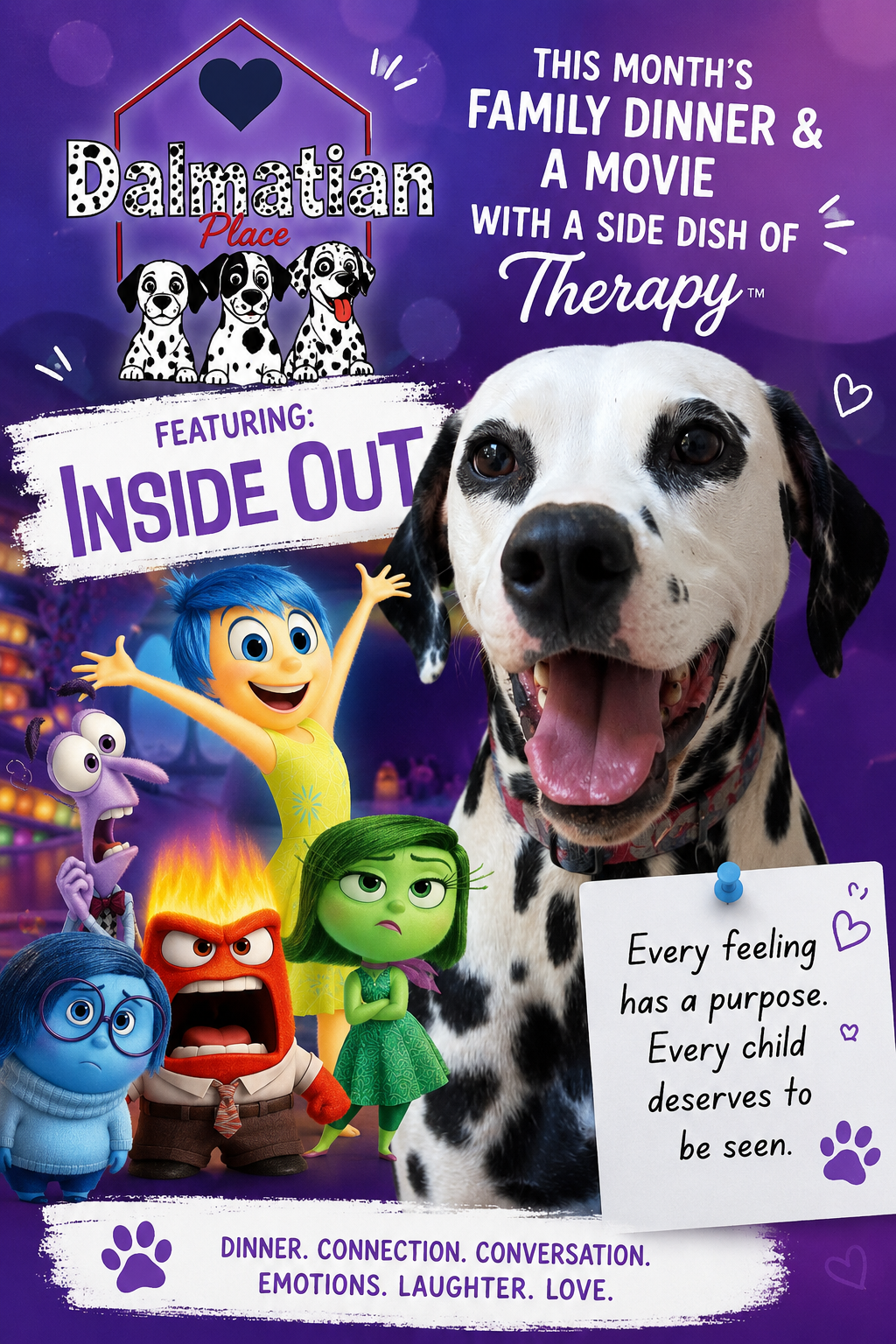
🌈 Family Dinner & a Movie with a Side Dish of Therapy, Inside Out Movie Night: Helping Kids Understand Big Feelings Through Play, Connection, and Conversation
By Jessica Anderson, MS, LPC, TraumaPlay, EMDR, Level 1 AAPT
Dalmatian Place | Longview, Texas
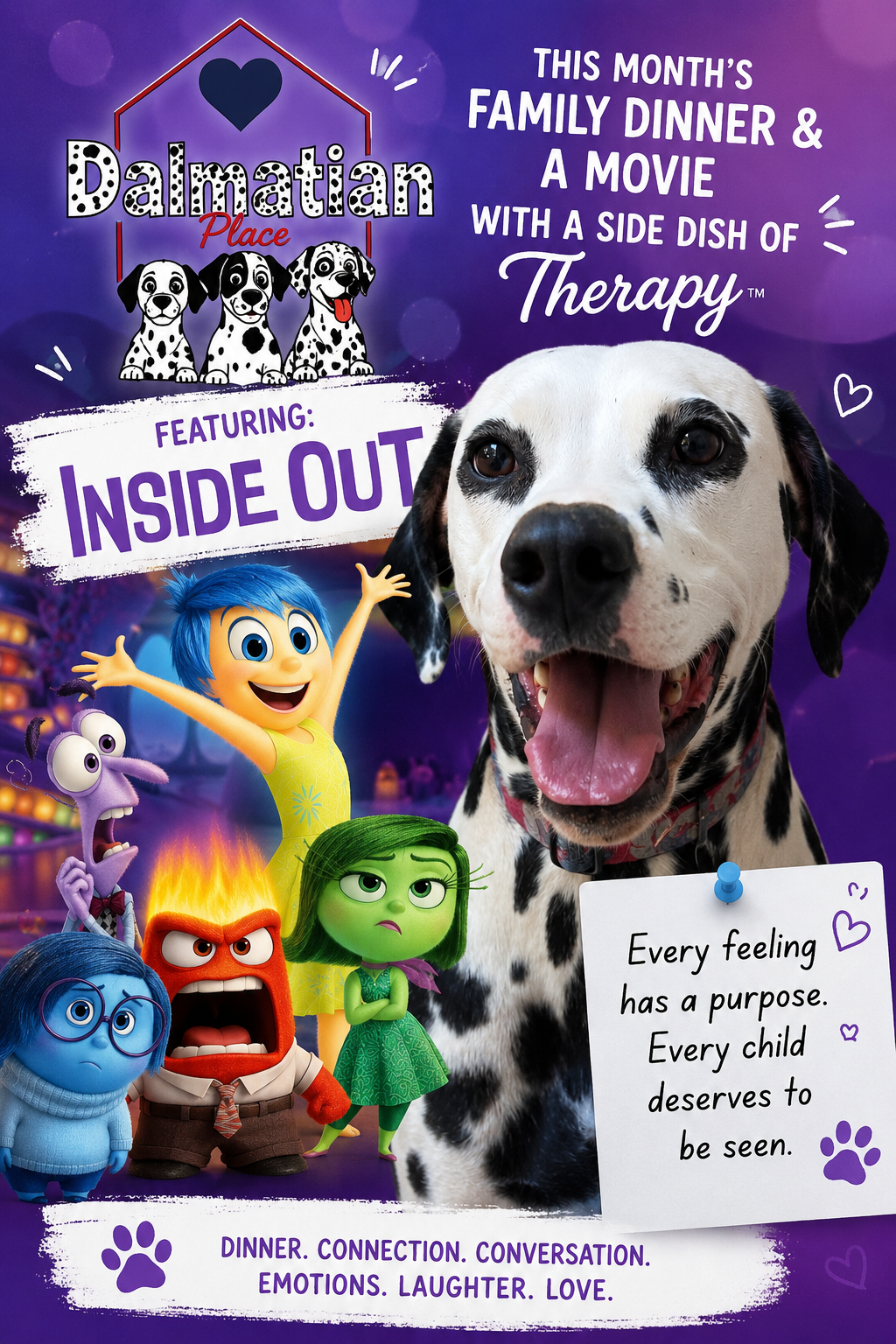
Looking for a fun family movie night that also helps your child build emotional awareness?
You're in the right spot.
At Dalmatian Place, we believe therapy doesn't always have to happen in a counseling office.
Sometimes?
It begins over tacos.
Sometimes?
It begins with a scoop of ice cream.
And sometimes?
It begins when a child finally feels truly seen.
This month's Family Dinner & a Movie with a Side Dish of Therapy features one of my favorite family movies because it reminds us of something every child desperately needs to know:
Every feeling belongs.
🐾 Let's Go Spot Some Feelings 🐾
Have you ever noticed how easy it is to spot a Dalmatian?
Their spots are impossible to miss.
But here's what I love even more, Dalmatians teach us something about parenting.
They don't hide their spots. They wear them proudly.
Children have "spots," too.
Not on their fur, lol, of course, but in the little clues they leave behind every day.
The child who suddenly gets quiet after school.
The one who melts down over the blue cup.
The teenager who shrugs and says, "I'm fine."
The little one who asks for one more hug.
The child who laughs until they snort.
Those are all spots.
They're clues.
And every clue is inviting us to look a little closer.
At Dalmatian Place, we aren't trying to spot bad behavior.
We're learning to spot the needs underneath it.
Because:
Behavior is a clue, not a character flaw.
🌮 Dinner: Headquarters Taco Bar
Tonight, dinner becomes part of the conversation.
Instead of choosing toppings because they're your favorite, we encourage you to choose toppings that represent how your week has felt.
Slow Cooker Salsa Chicken
Ingredients
2–3 pounds boneless skinless chicken breasts
1 packet taco seasoning
1 jar of your favorite salsa
Juice of one lime
Directions
Place everything in your slow cooker.
Cook on LOW for 6–7 hours (or HIGH for 3–4 hours).
Shred with two forks and stir back into the juices.
Serve with tortillas and your feelings-inspired toppings.
🌈 Feeling Toppings
❤️ Hot Salsa = Anger
"What felt unfair this week?"
💛 Sweet Corn = Joy
"What made you laugh so hard you couldn't stop?"
💙 Sour Cream = Sadness
"What felt heavy?"
💚 Guacamole = Disgust
"What didn't feel right?"
💜 Purple Cabbage = Fear
"What made you nervous?"
🧡 Crunchy Tortilla Strips = Anxiety
"What kept your brain busy?"
🩷 Cheese = Embarrassment
"When did you wish you could disappear?"
🤍 Cilantro = Calm
"When did you finally breathe?"
Then ask:
"Tell us the story behind your taco."
🍨 Headquarters Sundae Bar
If tacos tell the story of your week...
Your sundae tells the story of your heart.
Ice Cream
Vanilla
Chocolate
Your favorite!
Toppings
❤️ Strawberries
💙 Blueberries
💛 Bananas
💚 Kiwi
💜 Grape Gummies
🧡 Reese's Pieces
🩷 Rainbow Sprinkles
🤎 Hot Fudge
☁️ Whipped Cream
🍪 Cookie Crumbles
🍒 Cherries
⭐ Gold Star Sprinkles
Ask:
"If your sundae could talk, what would it say about your week?"
🫐 Blueberry Memory Mocktail
Ingredients
3 cups blueberry lemonade
2 cups sparkling lemonade or lemon-lime soda
Frozen blueberries
Lemon slices
Fresh mint
Ice
Blue sanding sugar (optional)
Edible glitter (optional)
Directions
Mix blueberry lemonade with sparkling lemonade.
Pour over ice.
Add frozen blueberries, lemon slices, and mint.
Finish with edible glitter if you want a little movie magic.
Toast together:
"Here's something I noticed about you this week..."

🎬 Before the Movie
Spot the Spot Challenge
Each family member secretly chooses someone else at the table.
Your mission all evening?
Notice them.
Really notice them.
Look for:
⭐ Courage
❤️ Kindness
😂 Humor
💪 Persistence
🎨 Creativity
🤗 Compassion
You aren't allowed to tell them yet.
Just keep spotting.
🍿 After the Movie
Spotlight Circle
One person sits in the "spotlight."
Everyone else finishes this sentence:
"Here's what I spotted about you tonight..."
Examples:
"I spotted how patient you were."
"I spotted how brave you were."
"I spotted how you kept trying."
"I spotted how kind you were to your brother."
"I spotted your funny dance moves."
No correcting.
No advice.
No "but..."
Just delight.
Children don't simply need to be loved.
They need to feel delighted in.
🐾 NEW! Spot Your Spots Activity
Download our free Spot Your Spots Coloring Page featuring Stitch, Dalmatian Place's four-legged therapy helper!
Instead of coloring the spots black, fill each large spot with something someone noticed about you tonight.
Examples:
I am brave.
I am kind.
I helped my sister.
I tried something hard.
I made someone laugh.
I kept going.
When you're finished, hang your Dalmatian somewhere you'll see it all week.
Because sometimes we all need a reminder that someone noticed the good in us.
🧠 The Side Dish of Therapy
One of the greatest gifts we can give our children isn't fixing their emotions.
It's helping them feel seen while they experience them.
Children don't build secure attachment because parents always say the perfect thing.
They build secure attachment because someone notices them.
Someone slows down.
Someone becomes curious.
Someone says,
"Tell me more."
That changes brains.
That changes relationships.
That changes families.
❤️ Final Thought
At Dalmatian Place, we're on a mission to help families become better spotters.
Spot the courage.
Spot the effort.
Spot the kindness.
Spot the needs underneath the behavior.
Spot the child before the behavior.
Because when children feel truly seen...
They begin to believe they are worth seeing.
And maybe?
That's one of the greatest gifts we can ever give them.
Frequently Asked Questions
Is Inside Out a good movie for young children?
Yes! While some themes may prompt deeper conversations, the movie is an excellent opportunity to help children learn that all emotions have a purpose. Parents can tailor the discussion to their child's age and developmental level.
What age is this activity best for?
The activities work well for children ages 4–12, but older children and teens often enjoy the conversation prompts, too. Adults may find themselves learning just as much as their kids.
What if my child doesn't want to talk?
That's okay! The goal isn't to force conversation. Simply participating in the meal, the activities, and the movie creates opportunities for connection. Children often open up later when they feel safe and unpressured.
Why use food to talk about feelings?
Creative activities lower pressure and invite conversation naturally. Building tacos and sundaes becomes a playful way to explore emotions without making children feel like they're in a formal discussion.
What is the "Spot Your Spots™" activity?
Children fill the large spots on their Dalmatian coloring page with positive qualities, strengths, or moments someone noticed about them during the evening. It's a keepsake that reinforces delight, belonging, and emotional connection.
Why does Dalmatian Place use "spots" as a metaphor?
At Dalmatian Place, we believe children are constantly giving us clues about what's happening inside them. Just as a Dalmatian's spots are part of what makes them unique, every child's emotions, behaviors, and strengths tell part of their story. We help families learn to spot clues instead of flaws.
Do you offer therapy for children in Longview, Texas?
Yes! Dalmatian Place provides trauma-informed, play-based therapy for children and families in Longview, Texas. We specialize in helping children navigate anxiety, trauma, neurodivergence, attachment challenges, emotional regulation, and family relationships through developmentally appropriate, connection-focused care.
Ready to Create Your Own Family Tradition?
Download the free shopping list, Spot Your Spots™ printable, and Spotted Badge to make your own Family Dinner & a Movie with a Side Dish of Therapy™ night at home.
If you're in the Longview area and you're looking for support for a child who struggles with big emotions, anxiety, trauma, or behavioral challenges, we'd love to walk alongside your family.
Because healing doesn't begin when behavior changes.
Healing begins when someone feels seen. 🐾❤️
Why Kids Misbehave Most Around the People They Feel Safest With (And What Lilo & Stitch Can Teach Us About It)
Your Child Isn't Saving Their Worst Behavior for You...
They're Saving Their Safest Feelings.
One of my favorite moments in Lilo & Stitch isn't funny.
It isn't Stitch surfing.
It isn't the chaos.
It's watching Lilo continue to love someone whose nervous system is constantly preparing for danger.
Because if I’m being honest? That's what many parents are living every single day.
Your child walks into school and holds it together.
Grandma says they were "perfect."
The teacher says they had a great day.
Then they get in the car with you...
…and everything falls apart.
I’m talking the meltdowns, the crying, the yelling, the aruing.
Sometimes complete silence.
And as parents, we naturally wonder:
"Why me?"
But what if the answer is actually beautiful?
Spot the Clue 🐾
At Dalmatian Place, we spend a lot of time spotting clues instead of flaws.
Here's one of my favorite clues:
Children usually fall apart where they feel safest.
Think about Stitch.
He spent his whole life preparing for danger.
Running.
Fighting.
Protecting himself.
Even after he found his Ohana, his nervous system didn't instantly believe he was safe.
Healing took time.
Our kids are often exactly the same.
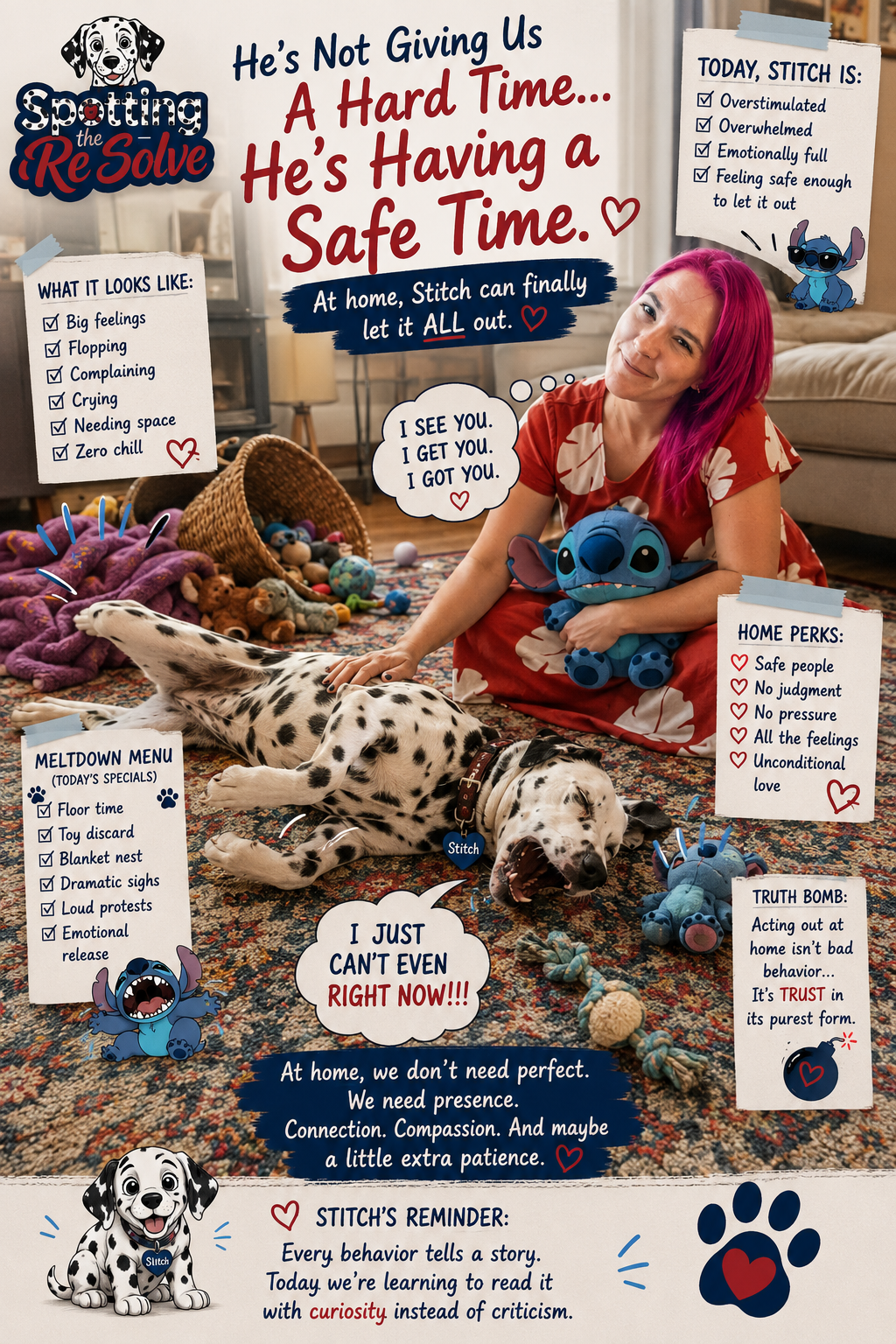
The Emotional Navigator
I often tell families:
Your child's brain has its own little navigation system.
Sometimes that GPS is using an old map.
Their brain keeps saying,
"Watch out!"
even though today is actually safe.
That's why I call it becoming an Emotional Navigator.
Instead of asking:
"How do I stop this behavior?"
We start asking:
"What is this behavior trying to tell me?"
That is the MAGIC,and when things start to Change!
What If Your Child Isn't Giving You Their Worst...
What if they're giving you their safest?
The place where they finally don't have to pretend.
The place where they can let the mask fall off.
The place where they know someone will stay.
That's a completely different story.
Three Clues to Spot This Week
🐾 Spot #1
Notice when the meltdown happens.
Is it after swim lessons?
Bedtime?
Leaving an activity?
Transitions tell us a lot.
🐾 Spot #2
Instead of correcting first...
Get curious first.
"What happened today?"
"I wonder if your brain has been working really hard."
“I’m noticing”
“Your body is letting me know that you are feeling really tired”
🐾 Spot #3
Remember:
Connection calms before correction teaches.
A regulated adult is one of the greatest gifts we can give a dysregulated child.
What Lilo Got Right
Lilo wasn't perfect.
Nani wasn't perfect.
Stitch definitely wasn't perfect.
But they kept showing up for one another.
Healing doesn't happen because families never struggle.
Healing happens because someone stays.
That's what Ohana really looks like.
From My Heart, Miss Jess’s Corner
I know how exhausting this season can be.
I'm a mom of five.
I've celebrated milestones, survived meltdowns, questioned myself, cried in the car, and wondered if I was getting any of it right.
I've also learned something that completely changed the way I parented:
Kids don't need perfect parents.
They need parents who stay curious.
Who repair.
Who keep showing up. Who DELIGHT in WHO they are!
That's why I built Dalmatian Place the way I did.
Not because I have all the answers.
But because I've lived long enough to know that families deserve support, not judgment.
I want every parent who walks through my doors to feel like they're sitting across from a friend over coffee, not being evaluated.
Because parenting is hard.
And it becomes so much lighter when someone helps you start spotting clues instead of flaws.
Want to Practice Spotting Clues?
Download this week's free printable:
A simple one-page family activity that helps parents notice:
When emotions show up
What happened right before
What helped
One thing to celebrate today
Small moments become big breakthroughs when we start noticing the clues.
Looking Ahead
At the end of this month, we will be diving into another favorite family movie.
We're talking about Emotions!
And what happens when every feeling has something important to say.
(If you know...you know. 😉)
Frequently Asked Questions
Why does my child only melt down at home?
Home is often the place where children finally feel safe enough to release all the stress they've been holding in throughout the day. While it doesn't make the behavior easy, it can be a sign that your child trusts you enough to let their guard down.
Is my child manipulating me?
Most children aren't trying to manipulate—they're communicating. Big behaviors often signal an overwhelmed nervous system rather than intentional defiance.
How can play therapy help my child?
Play is a child's natural language. Through play therapy, children can safely express feelings, process experiences, and develop healthier ways to regulate emotions when words alone aren't enough.
Can EMDR help children with anxiety or trauma?
Yes. EMDR can help children process overwhelming experiences so their brains no longer respond as though the danger is still happening. We adapt EMDR in child-friendly ways using play, creativity, and developmentally appropriate techniques.
When should I reach out for support?
If your child's emotions are interfering with daily life, family relationships, school, sleep, or if you're feeling overwhelmed as a parent, you don't have to figure it out alone.
❤️ Before You Go...
If no one has told you this lately...
You're probably doing better than you think.
Parenting children with big emotions isn't easy.
Some days you'll stay calm.
Some days you'll lose your patience.
Some days you'll wonder if you're getting any of it right.
I have those days too.
The goal isn't perfection.
The goal is connection.
Because children don't need perfect parents.
They need parents who are willing to come back, repair, and keep showing up.
This week, I want to leave you with one simple challenge.
Instead of asking,
"How do I stop this behavior?"
Try asking,
"What is my child trying to tell me?"
When we stop chasing the behavior and start spotting the clues, we often discover a child who isn't trying to make life difficult…
They're simply hoping someone will understand.
And maybe...
Just maybe...
That someone can be us.
❤️🐾
From My Family to Yours,
Thank you for letting me be a small part of your parenting journey.
Whether we ever meet in my therapy office or simply connect here each week, I hope Dalmatian Place feels like a place where you and your family can breathe a little easier.
Because every child deserves to be seen.
Every parent deserves grace.
And every story deserves someone willing to look beyond the behavior.
Until next time...
Keep spotting the clues.
❤️ Jessica Anderson, LPC
Founder, Dalmatian Place in Longview, TX
Spotting the ReSolve
"Restoring joy, one spot at a time."
Why Your Child Can't "Just Move On"(And Why That Doesn't Mean You're Doing Anything Wrong)
Wondering why your child can't seem to move on after something scary or overwhelming? Learn how trauma affects the brain, why behavior is a clue, and how EMDR therapy can help children and adults heal at Dalmatian Place in Longview, Texas.
If you've ever found yourself thinking...
"We've talked about this a hundred times."
"That happened years ago."
"Why can't they just let it go?"
Friend, you're not alone AND more importantly:
your child probably isn't choosing to stay stuck.
At Dalmatian Place, we say something often:
Behavior is a clue, not a character flaw.
Sometimes the biggest clue isn't what your child is doing...
It's what their brain is still trying to protect them from.

🐾 Stitch Taught Me Something About Brains
If you've followed us for very long, you've probably met Stitch—our Dalmatian, Chief Spotter of Clues, and unofficial office greeter.
One thing about Stitch?
He notices everything.
A squirrel.
A rabbit.
A leaf blowing across the yard.
A new smell on yesterday's walking trail.
He's always spotting something.
Usually he sniffs it…
Decides it's safe…
And keeps walking.
But every once in a while...
He finds something that makes him stop.
Maybe another dog barked unexpectedly.
Maybe a loud truck came around the corner.
Maybe fireworks exploded overhead.
The next walk?
He notices every sound.
Every movement.
Every shadow.
Not because he's stubborn.
Because his brain is trying to keep him safe.
Children's brains work the very same way.
Your Child Isn't Giving You a Hard Time...
They Might Be Having a Hard Time.
When something overwhelming happens...
our brains don't always get the chance to file that memory away.
Instead...
It gets left sitting out on the kitchen counter.
Every day.
Every reminder.
Every smell.
Every sound.
Every similar situation...
Your brain trips over it all over again.
That's why a child who was bitten by one dog suddenly becomes afraid of every dog.
Why a child who experienced bullying panics before school.
Why an adult who grew up walking on eggshells still feels anxious decades later.
The story isn't over in the nervous system.
It's still trying to protect them.
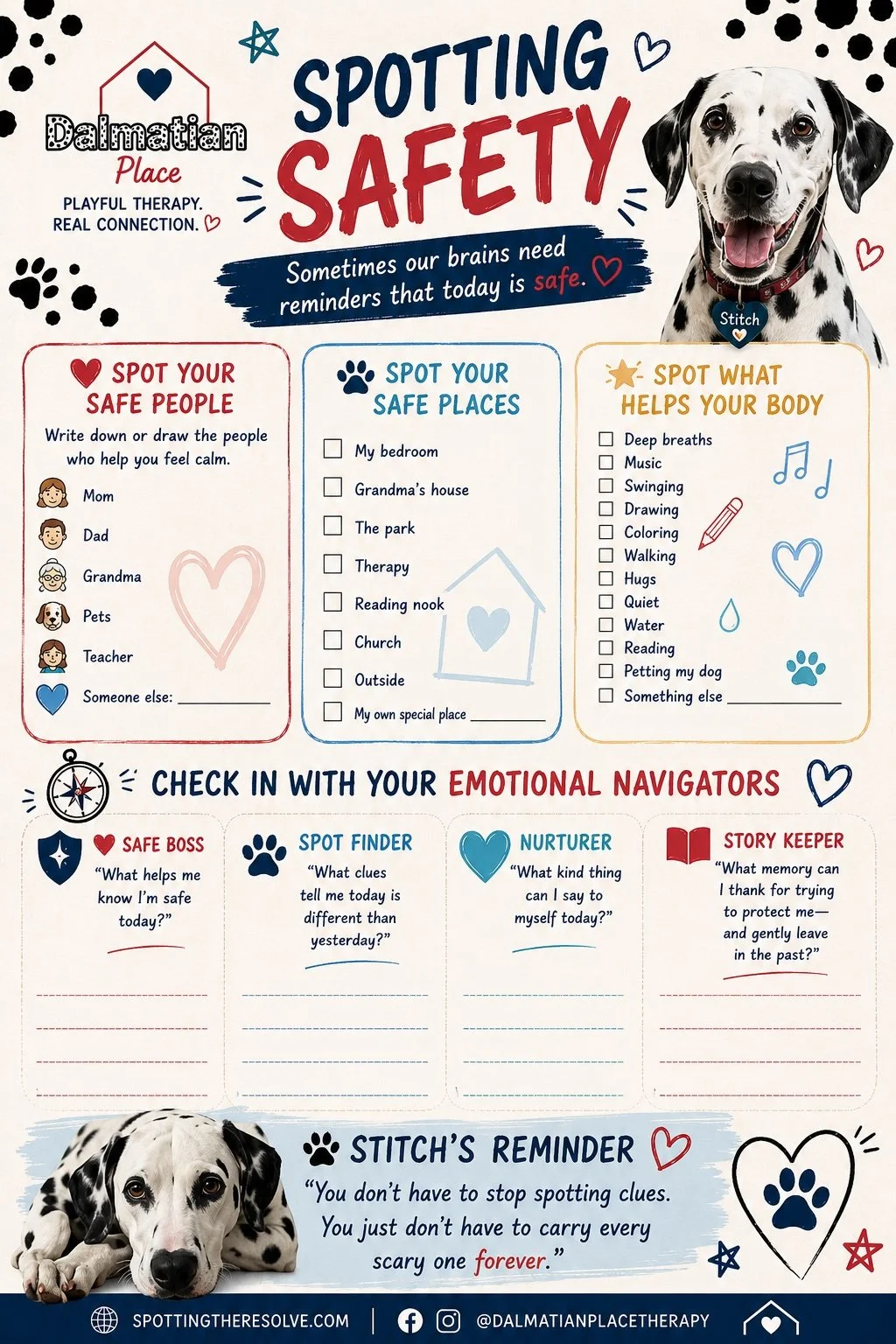
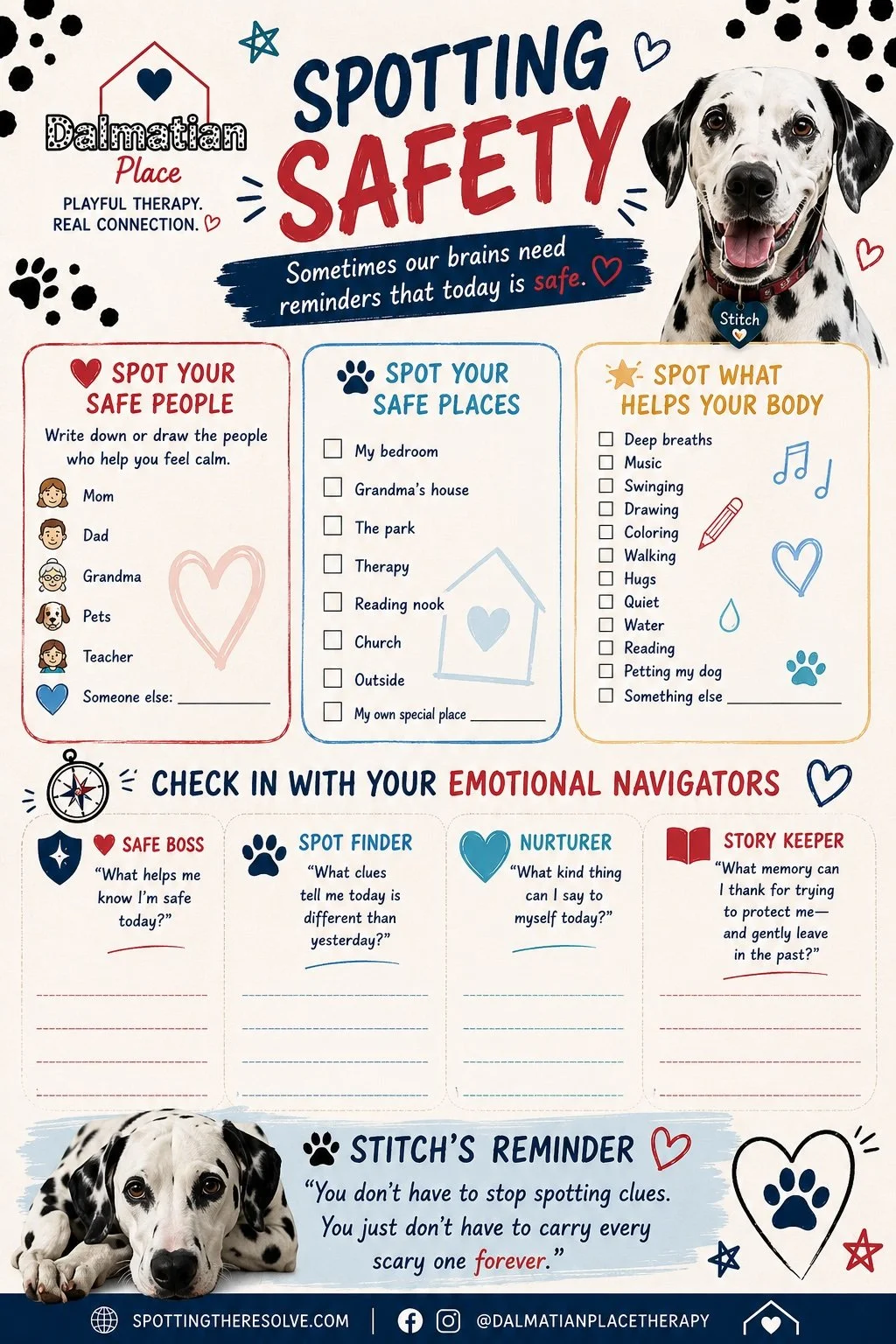
🧭 Meet Your Emotional Navigators
One of the ways we understand healing at Dalmatian Place is through our Emotional Navigator Framework.
Instead of seeing behaviors as "good" or "bad," we get curious about what each part of us is trying to communicate.
❤️ The Safe Boss
The Safe Boss is always scanning.
"Are we okay?"
"Is this person safe?"
"Do I need to protect us?"
Sometimes after trauma...
The Safe Boss starts seeing danger everywhere.
Even when we're finally safe.
🐾 The Spot Finder
Our Spot Finder notices everything.
Tone of voice.
Facial expressions.
Body language.
Changes in routine.
Tiny clues that other people never even notice.
When we've lived through hard things...
our Spot Finder becomes incredibly good at finding danger.
The problem?
Sometimes it keeps spotting danger that isn't actually there anymore.
🤍 The Nurturer
The Nurturer reminds us:
"You don't have to do this alone."
Healing happens in safe relationships.
Children don't need perfect parents.
They need parents who are willing to stay close.
📖 The Story Keeper
Every experience becomes part of our story.
But difficult experiences aren't supposed to stay in the "right now" folder forever.
The Story Keeper's job is to gently place those memories where they belong—
in the past.
So they stop interrupting the present.
So...Where Does EMDR Fit?
I think EMDR is often explained in ways that sound intimidating.
Here's how I explain it.
Imagine your brain is a beautifully organized library.
Most memories get placed on the correct shelf.
Easy to find.
Easy to put away.
Trauma?
Trauma gets dropped in the middle of the floor.
Every time you walk through...
You trip over it.
EMDR helps your brain finally pick up that memory...
Understand it...
Process it...
And place it on the shelf where it belongs.
You still remember it.
It just doesn't feel like it's happening all over again.
That's healing.
Hope for Parents
If you're reading this because your child melts down over "small things"...
Or your teen seems anxious all the time...
Or maybe you're the one carrying a story that still feels heavy...
I want you to know something.
There isn't anything wrong with you.
Sometimes your brain is simply doing exactly what it was designed to do—
protect you.
Together, we can help it learn that today is different than yesterday.
From One Mom to Another...
Before I'm a therapist...
I'm a mom.
Five kids.
Two who have already left the nest.
Three who still keep me humble every single day.
I've packed lunches.
Sat through teenage silence.
Wondered if I was getting it right.
Cried behind closed doors.
Celebrated tiny wins that nobody else noticed.
I've lived enough life to know there isn't a perfect way to parent.
There is only a connected way.
I don't sit across from parents because I've read all the books.
I sit with them because I know what it's feels like to desperately want your child to feel safe, confident, and happy—and to wonder if you're missing something.
That's why Dalmatian Place exists.
To help families stop chasing behaviors...
And start spotting the clues underneath them.
Because once we understand the clue...
Healing becomes possible.
🐾 Keep Spotting the Clues
Every behavior tells a story.
Every emotion points toward a need.
Every child deserves someone willing to get curious instead of critical.
And every family deserves hope.
If you're ready to understand what's underneath the behaviors—not just manage them—we'd be honored to walk alongside you.
At Dalmatian Place, we're restoring joy, one spot at a time.
Frequently Asked Questions
How do I know if my child needs EMDR therapy?
Many parents assume trauma has to involve something dramatic, but that's not always true.
Sometimes children need extra support after:
Divorce
Adoption or foster care
Medical procedures
Bullying
A car accident
The loss of someone they love
Anxiety that never seems to turn off
Repeated "big reactions" that don't match the situation
If your child seems stuck in fear, worry, anger, or shutdown—even when life is safer now—it may be because their brain is still trying to protect them.
That's where EMDR can help.
What age can children start EMDR?
One of the things I love most about EMDR is that it can be adapted for children.
At Dalmatian Place, EMDR with children rarely looks like what most adults imagine.
It might involve:
🐾 Play
🐾 Movement
🐾 Stories
🐾 Art
🐾 Stuffed animals
🐾 Games
🐾 Bilateral stimulation that's woven naturally into therapy
Children don't have to sit on a couch and talk for an hour. They process through play, because play is their language.
Does my child have to talk about what happened?
No.
In fact, many children aren't ready—or don't even have the words—to explain their experiences.
One of the beautiful things about EMDR is that healing doesn't always require retelling every detail.
Instead of forcing children to relive painful memories, we help their brains safely organize those experiences so they no longer feel like they're happening right now.
That often feels much safer for children who have experienced trauma.
My child has big meltdowns. Could trauma be part of the reason?
Sometimes.
Not every meltdown is trauma.
But many behaviors parents worry about are actually clues rather than problems.
Children might:
explode over small things
become extremely anxious
avoid school
have nightmares
struggle to separate from parents
become aggressive
seem "too sensitive"
shut down completely
Rather than asking, "What's wrong with my child?" I encourage parents to ask,
"What is this behavior trying to tell us?"
That's the beginning of spotting the clues.
Is EMDR only for PTSD?
No.
EMDR is widely known for treating trauma, but it can also be helpful for children experiencing:
Anxiety
Grief
Attachment wounds
Adoption-related challenges
Medical trauma
Low self-esteem
Panic
Phobias
Performance anxiety
Emotional regulation difficulties
Every child is different, which is why therapy should be individualized rather than one-size-fits-all.
What makes Dalmatian Place different?
I'm not interested in "fixing" kids.
I'm interested in understanding them.
At Dalmatian Place, we use play, relationship, attachment, nervous system regulation, and evidence-based therapies like EMDR to help children—and the adults who love them—make sense of what's underneath the behavior.
Our philosophy is simple:
Behavior is a clue, not a character flaw.
We believe healing happens when children feel safe enough to be known, understood, and connected.
That's why everything we do is centered around helping families slow down, spot the clues, and restore joy—one spot at a time.
How do I know if we're a good fit?
If you've ever found yourself thinking...
"Nothing we've tried seems to work."
"I know my child is a good kid."
"I feel like I'm failing."
"I just want home to feel peaceful again."
…I want you to know you're not alone.
As a therapist—and as a mom of five—I understand both sides of this journey.
I've experienced the exhaustion of trying to help a struggling child while wondering if you're getting it right. I know what it's like to carry the mental load, second-guess your decisions, and wish someone would simply help you understand what's really going on.
That's why I created Dalmatian Place.
Not to hand out parenting scripts or behavior charts, but to walk alongside families as we spot the clues together.
Because when we understand what's underneath the behavior, everything begins to make a little more sense.
And hope starts to return.
Ready to Spot the Clues?
You don't have to figure this out alone.
Whether your child is struggling with anxiety, trauma, emotional outbursts, or simply feeling "stuck," there's a path forward—and it begins with curiosity, connection, and understanding.
If you're ready to learn what's underneath the behavior, I'd love to help.
At Dalmatian Place, Longview’s Family Therapy Center, we're restoring joy, one spot at a time.
👉 Schedule a consultation or learn more at SpottingTheResolve.com
Behavior Is Still Communication… Even After Age 10
Behavior Is Still Communication… Even After Age 10
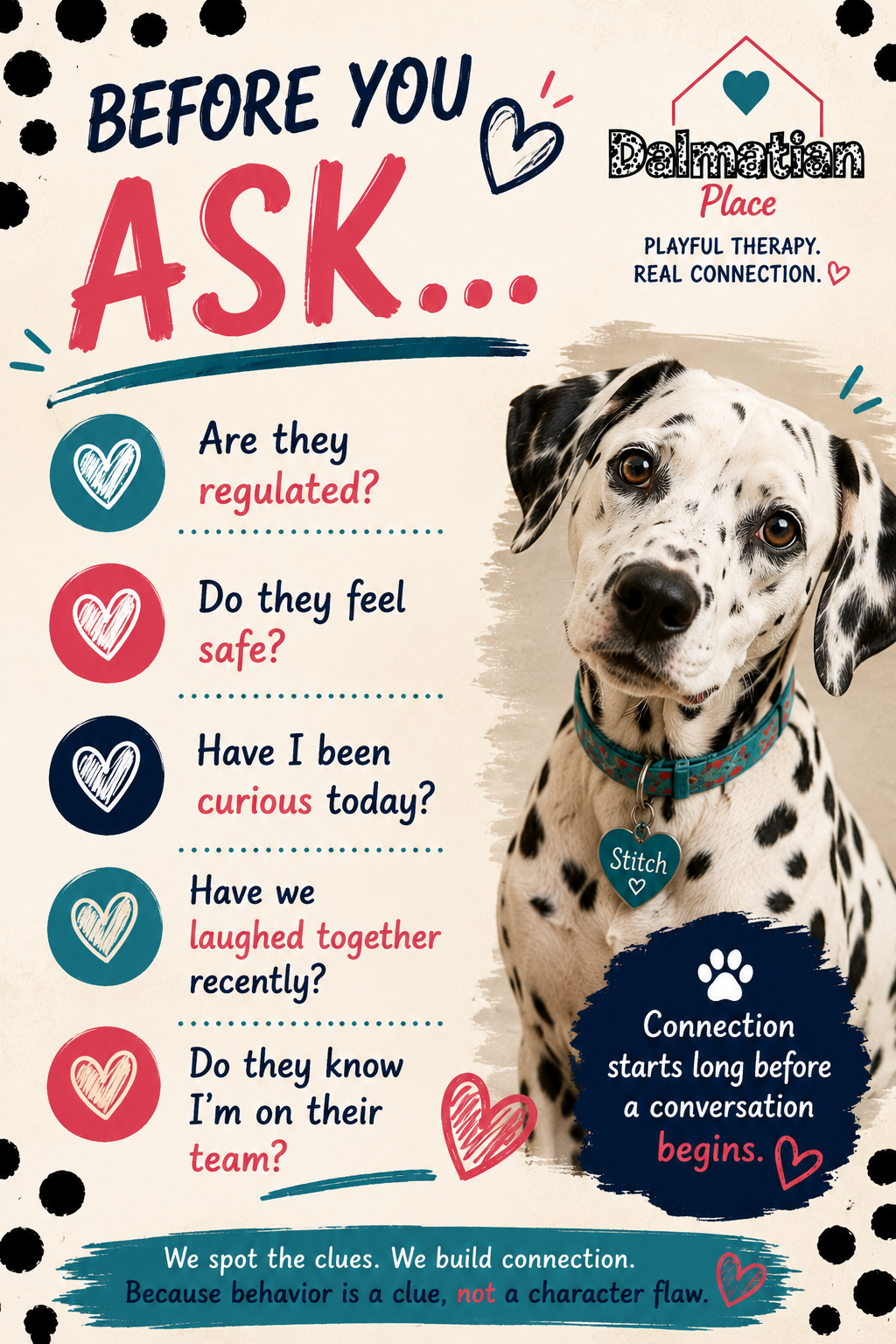
"The clues don't disappear as children get older. They just become a little harder to spot."
If you've been around Dalmatian Place for very long, you've probably heard me say:
Behavior is a clue, not a character flaw.
It's one of the beliefs that guides everything I do as a therapist.
But here's something I think parents need to hear:

That doesn't stop being true once children get older.
Somewhere along the way, we start expecting older kids and teenagers to simply tell us what's wrong.
We say things like:
"Just use your words."
"Tell me what's going on."
"Why are you acting like this?"
And when all we get back is...
"I don't know."
"I'm fine."
"Leave me alone."
...it can feel like they've stopped communicating with us.
But they haven't.
They've simply found different ways to tell their story.
Spot the Clues 👀
Older children don't usually throw themselves on the grocery store floor anymore.
Instead, their behavior might look like:
🐾 Spending all their time alone in their room
🐾 Becoming irritable over small things
🐾 Being overly responsible or perfectionistic
🐾 Suddenly refusing activities they used to enjoy
🐾 Becoming anxious about things that never bothered them before
🐾 Snapping at siblings
🐾 Shutting down when emotions get big
🐾 Saying, "I don't care," when they really care deeply
These behaviors can be frustrating.
But before we ask,
"How do I make this stop?"
I wonder if we could ask a different question.
What might this behavior be trying to tell me?
Sometimes the Loudest Behaviors Are Covering the Quietest Feelings
Children don't always have words for things like:
"I'm overwhelmed."
"I don't feel safe."
"I'm scared I'll disappoint you."
"I don't know why my heart won't stop racing."
"I miss when things felt different."
"I feel left out."
"I don't know how to ask for help."
Instead...
Their nervous system speaks first.
Their behavior becomes the message.
That doesn't mean every behavior is acceptable.
Boundaries are still important.
Consequences still have a place.
But connection almost always comes before correction.
Because children who feel understood are much more likely to become children who can understand themselves.
The Brain Remembers What the Mouth Can't Explain
One of the reasons I love working with trauma and anxiety is that sometimes children truly don't know why they're reacting the way they are.
Our brains are incredible.
They are designed to protect us.
Sometimes, after difficult experiences, the brain keeps sounding an alarm long after the danger has passed.
That can look like:
❤️ Big emotions that seem to come out of nowhere
❤️ Worry that doesn't make sense
❤️ Difficulty sleeping
❤️ Trouble concentrating
❤️ Feeling "stuck"
It's not because children are deliberately being difficult.
Often, it's because their nervous system is working overtime to keep them safe.
This is one of the many reasons I use approaches likeEMDR therapyalongside play therapy with children, teens, and adults. Healing isn't always about finding the perfect words. Sometimes it's about helping the brain and body realize they're finally safe.
I'll be sharing more about EMDR in the coming weeks because it's one of the most misunderstood—and most effective—tools I use with families.
Why This Matters So Much to Me
If I'm honest...
I don't write these movie nights because I have everything figured out.
I write them because I'm living this too.
I'm a mom of five amazing kids. Two have already grown up and left the nest, and three are still keeping me on my toes every single day.
So when I tell you that connection is hard sometimes...
I mean it.
I've had the one-word answers.
I've had the slammed doors.
I've had moments when I wondered whether I was saying the right thing or if I should say anything at all.
I've had seasons when life felt so busy that everyone was simply surviving the week.
That's one of the reasons Dalmatian Place exists.
Not because I believe families need to be perfect.
Because I believe families deserve places where they can breathe.
I've learned something over the years—both as a therapist and as a mom:
The little moments matter more than we think.
The conversation in the car.
Laughing over dinner.
Watching a movie together.
The five extra minutes before bed.
Those moments don't always look important while they're happening.
But they become the memories our children carry.
I'm not inviting you into a perfect family. I'm inviting you into a family that's still learning that connection grows in ordinary moments. That's the kind of family I'm raising too.

I Don't Want to Give You More to Do.
I know you're already carrying enough.
You're juggling work.
School.
Activities.
Laundry.
Dinner.
Homework.
The mental load of remembering everyone's everything.
The last thing you need is another parenting expert handing you a list of twenty things you're supposed to do better.
That's never been my heart.
I want to make connection feel possible again.
Sometimes that means planning dinner for you.
Sometimes it means giving you five conversation starters.
Sometimes it means helping you understand the behavior you've been trying so hard to "fix."
Because underneath almost every behavior...
...there's a child asking,
"Am I safe?"
"Do I belong?"
"Will you stay with me?"
That's Why I Created Family Dinner & a Movie.
Not because I think one movie changes a family.
But because one evening can.
One laugh.
One honest conversation.
One memory.
One moment where someone feels seen.
Those little moments have a way of becoming something much bigger.
That's what I'm hoping these movie nights become for your family.
Not another thing on your calendar.
A tradition.
And If You Need More Than a Movie Night...
Sometimes families need a little extra support.
Not because anyone has failed.
Not because anyone is broken.
Just because parenting is hard, relationships get messy, and all of us need someone in our corner sometimes.
If that's where you are today, I'd love to walk alongside your family.
At Dalmatian Place, we don't just look at behavior.
We spot the clues.
We slow down.
We get curious together.
And we help children, teens, and parents reconnect in ways that feel safe, playful, and genuine.
Because there really is a gentler way.
And I'd love to help you find it.
Here's My Challenge for You This Week
The next time your child has a big reaction…
Pause for just a moment.
Instead of asking:
"What's wrong with my child?"
Try asking:
"What clue might I be missing?"
You don't have to have all the answers.
You just have to stay curious.
Because curiosity opens doors that criticism never will.
Keep Spotting the Clues ❤️
If this week's blog resonated with you, I think you'll love our new Family Dinner & a Movie with a Side Dish of Therapyseries.
Our first movie night features Lilo & Stitch, with easy dinner ideas, conversation starters, printable activities, and playful ways to help your family build connection—right from your own living room.
It's completely free because I believe some of the most meaningful therapy moments don't always happen in my office.
Sometimes they happen around your dinner table.
And if you're finding that your child's behavior keeps leaving you wondering what they're trying to tell you, I'd love to help.
At Dalmatian Place in Longview, Texas, I work with children, teens, adults, and families using playful, trauma-informed approaches—including Play Therapy and EMDR—to help uncover what lies beneath the behavior.
Because every child deserves someone willing to look beyond the behavior...
...and spot the clues.
🐾 Stitch Spotted This: "Sometimes teenagers say the most with a shrug."
Frequently Asked Questions
Why won't my teenager talk to me anymore?
As teens grow, they naturally seek more independence. Pulling away doesn't always mean they don't want a relationship—it often means they're learning how to navigate emotions in new ways. Creating emotional safety instead of pressuring them to talk often leads to more meaningful conversations over time.
How can I get my teenager to open up?
Focus less on asking lots of questions and more on spending relaxed, pressure-free time together. Watching a movie, taking a drive, cooking dinner, or sharing an activity often creates opportunities for conversation that feel more natural.
Is it normal for teenagers to pull away from their parents?
Yes. Some distance is a typical part of adolescent development. However, if your teen becomes consistently withdrawn, isolated, angry, or overwhelmed, it may be helpful to seek additional support.
When should I consider therapy for my teenager?
Therapy may be beneficial if your teen is experiencing anxiety, depression, emotional outbursts, school avoidance, trauma, friendship difficulties, or if family communication feels stuck in constant conflict. Early support can strengthen relationships before problems become more overwhelming.
Do you offer therapy for teens in Longview, Texas?
Yes. At Dalmatian Place, we provide private-pay therapy for children, teens, parents, and families in Longview and throughout East Texas. We use trauma-informed, attachment-focused approaches to help families build stronger relationships and understand the "why" beneath behavior.
Can parents participate in therapy?
Absolutely. Parents are an essential part of the healing process. Depending on your family's goals, therapy may include parent coaching, family sessions, or individual support for your teen.
Still spotting clues, but not sure what they're telling you?
You don't have to figure it out alone.
At Dalmatian Place, we help families discover what's underneath the behavior so they can reconnect with confidence, compassion, and hope.
Whether your child is five or fifteen, connection is still possible.
If you're ready to stop guessing and start understanding, I'd love to walk alongside your family.
📍 Dalmatian Place
Family Therapy in Longview, Texas
📞 (903) 309-3656
✉️ Jessica@spottingtheresolve.com
Looking for Teen Therapy in Longview, Texas?
Dalmatian Place provides private-pay therapy for children, teens, and families in Longview, Texas. We specialize in trauma-informed, neurodiversity-affirming therapy that helps families strengthen connection, improve communication, and better understand the clues behind behavior.
Whether your teen is struggling with anxiety, trauma, emotional regulation, or simply feels disconnected, we're here to help your family reconnect.
📍 Serving Longview, Hallsville, White Oak, Kilgore, Gilmer, Marshall, Gladewater, and surrounding East Texas communities.
Ready to Learn More?
📍 Dalmatian Place | Family Therapy in Longview, Texas
📞 (903) 309-3656
✉️ Jessica@spottingtheresolve.com
🐾 Behavior is a clue, not a character flaw.
Family Dinner and a Movie (with a side dish of Therapy!)

There is just something magical about Friday nights.
The weekly chaos softens a little.
Everyone finally exhales.
And while family movie nights may seem small… these moments often become the things our children remember forever.
Not because everything was perfect.
Not because dinner looked Instagram-worthy.
But because connection happened there.
So welcome to our very first:
Family Dinner & a Movie Night
(….with a Side Dish of Therapy)
Where we take family movies we already love and gently explore the emotional themes hidden underneath them, all while sharing an easy dinner idea your nervous system can realistically handle after a long week.
And honestly?
For me, there was no better movie to start with than Lilo & Stitch! (and you get to pick, you can watch the original Animated version or you can go modern and watch the live-action remake from 2025).
This Week’s Movie:
Lilo & Stitch

On the surface, it is a funny movie about a chaotic blue alien destroying everything in sight.
But underneath?
It is a story about:
grief,
belonging,
emotional dysregulation,
attachment,
loneliness,
found family,
and the deep human need to feel safe with someone.
Honestly?
Stitch is what happens when trauma meets zero coping skills.
And Lilo?
Lilo is the child so many adults misunderstand. So many teachers get frazzled by. The child who often gets labeled as bad, wrong, different, or defiant. (Dare I say, the kids some places will label “Oppositional Defiant Disorder”?)
In reality though?
Lilo is :
Imaginative.
Sensitive.
Big-feeling.
Different.
Lonely.
Reactive.
And underneath all of that?
She is child that is grieving something that even seasoned adults don’t comprehend or know how to express.
For more on child emotional development, you can explore:
For trauma-informed parenting guidance, the National Child Traumatic Stress Network offers helpful resources: NCTSN
The “Side Dish of Therapy”
One of the most powerful things about this movie is that neither Lilo nor Stitch are “bad.”
They are dysregulated. There’s a BIG difference between “bad” and “dysregulated.
Children who have experienced stress, trauma, overwhelm, grief, instability, or disconnection often communicate through:
meltdowns,
aggression,
shutdowns,
clinginess,
avoidance,
defiance,
emotional chaos.
Not because they are trying to make your life harder. But because their nervous systems do not yet feel safe.
And honestly?
Adults do this too. (Just with better email etiquette and caffeine ;) )
The Therapy Takeaway:
Connection changes behavior more than shame ever will.
Throughout the movie, Stitch changes, not because someone punishes him enough…
…but because someone stays with him when things are hard.
Someone delights in him.
Someone sees beyond the behavior.
Someone becomes safe enough for him to soften.
That matters deeply for children.
Because healing often begins the moment a child realizes:
“Maybe I am not too much after all.”
🍍 Dinner Plan:
Hawaiian Sheet Pan Sliders
Prep Time: 10 minutes
Cook Time: 15 minutes
Serves: 4–6
Ingredients
1 package Hawaiian sweet rolls (12-count)
12 slices deli ham or turkey
6 slices Swiss, provolone, or mozzarella cheese
4 tablespoons butter, melted
1 teaspoon garlic powder
1 teaspoon Italian seasoning
Optional: pineapple rings cut into small pieces
Directions
Step 1:
Preheat oven to 350°F.
Step 2:
Without separating the rolls, slice the entire package in half horizontally.
Step 3:
Place the bottom half of the rolls on a sheet pan or baking dish.
Step 4:
Layer:
ham or turkey
cheese
pineapple pieces (optional)
Step 5:
Place the top half of the rolls back on.
Step 6:
Mix melted butter, garlic powder, and Italian seasoning.
Brush generously over the tops.
Step 7:
Cover loosely with foil and bake for 10 minutes.
Remove the foil and bake for another 5 minutes, until golden and melty.
Step 8:
Cut into individual sliders and serve.
Ohana Fruit Kabobs
Because every movie night needs something colorful.
Ingredients
Pineapple chunks
Strawberries
Blueberries
Grapes
Wooden skewers
Directions:
Let kids build their own kabobs.
Try alternating colors:
🍍 Pineapple
🍓 Strawberry
🫐 Blueberry
🍇 Grape
Repeat until the skewer is full.
(A fun side of therapy, make each color of fruit a different emotion and have kids build their kabobs to reflect their feelings over the week!)
Pineapple Ocean Mocktail
Ingredients
1 cup pineapple juice
½ cup lemon-lime soda or sparkling water
Splash blue sports drink or blue raspberry syrup
Ice
Optional: pineapple wedge, shark gummies, and tiny umbrellas
Directions
Fill cup with ice.
Pour:
pineapple juice first
blue drink second
soda last
Watch the colors swirl together like an ocean.
Add a tiny umbrella and shark gummies for bonus movie-night points.
🍍🐾 Bonus Spot of Joy
Pineapple Upside-Down Cake
1 box Pineapple Supreme Cake Mix
Ingredients called for on the box
1 can pineapple rings
Maraschino cherries
Frosting, white or cream cheese.
Directions
Step 1
Follow the directions on the box of cake mix.
Step 2
After the cake cools, frost with frosting of choice
Step 3
Decorate with pineapple rings and Maraschino cherries.
🐾 Spotting the ReSolve Family Challenge
During dinner, ask:
"What helps you feel like you belong?"
There are no wrong answers.
Some children will answer immediately.
Some will shrug.
Some will say:
"I don't know."
That's okay.
You can simply respond:
"Hmm. We can wonder about it together."
Sometimes safety begins when children discover they don't need the right answer.
Sometimes they just need someone willing to stay at the table with them while they figure it out.
And honestly?
That might be the most important ingredient in the whole meal.
Family Conversation Starters
(Keep it light. This is connection time — not an interrogation.)
Try:
“Which character felt misunderstood?”
“What do you think Stitch needed most?”
“Which part made you laugh the hardest?”
“What helps YOU feel safe when upset?”
“Who helped Stitch feel like he belonged?”
“What do you think Lilo needed from the grown-ups around her?”
🤍 And If Your Child Says:
“I don’t know.”
First:
Take a deep breath and resist the urge to immediately rephrase the question seventeen different ways.
“I don’t know” is often not a refusal.
It is protection.
Sometimes, children genuinely do not yet have the words for what they are feeling.
Sometimes their body does not feel safe enough to answer.
Sometimes they are still processing internally.
And sometimes direct questions can feel surprisingly vulnerable — especially for children carrying anxiety, trauma, shame, or overwhelm.
So instead of pushing harder, we shift to creating safety.
🐾 Becoming a “Safe Boss”
In TraumaPlay, we talk about becoming a Safe Boss.
Not scary boss.
Not a controlling boss.
Safe Boss.
A calm, regulated adult who helps a child’s nervous system know:
“You are safe with me.”
That can sound like:
“You don’t have to answer right away.”
“We can just wonder together.”
“Your body is letting me know this question might feel big.”
“It is okay if you don’t have words yet.”
“You’re not in trouble.”
“I like hearing your thoughts whenever you’re ready.”
Safety lowers defenses.
Pressure raises them.
🌺 The Power of a “Nurturer”
Children open up most when they feel emotionally received — not evaluated.
That means slowing down enough to:
sit beside them,
stay playful,
soften your tone,
and genuinely delight in who they are.
Not just in their “good behavior.”
But in them.
Sometimes the most healing thing a child experiences is an adult who:
laughs with them,
notices them,
stays calm,
and enjoys being with them without trying to fix them.
That is nurturer energy.
And children feel it deeply.
📖 Becoming a “Story Keeper”
Many children process experiences sideways before they process them directly.
So instead of:
“Tell me what you learned from the movie.”
Try:
“I wonder if Stitch felt lonely there.”
“That part seemed really big.”
“His body looked really overwhelmed.”
“I noticed Lilo kept trying to stay connected.”
This helps children borrow your nervous system and emotional language safely.
You are not forcing disclosure.
You are becoming a gentle story keeper:
Someone who helps organize emotional experiences into something understandable and safe.
And often?
That is when children begin talking naturally on their own.
Usually while staring at the ceiling.
Or holding a mozzarella stick.
Or five minutes after the conversation supposedly ended.
🌊 One Final Thought:
Ohana, Emotional Safety, and the Power of Staying
At the heart of Lilo and Stitch is a message children don’t always hear enough:
You do not have to be easy to love to be loved.
And for parents, the reminder is just as powerful:
You are not raising perfect behavior.
You are raising emotional safety.
And sometimes, the best therapy session is a couch, a movie, and a willingness to talk about what feelings showed up in the room.
Because in the end…
Ohana really does mean nobody gets left behind—or forgotten.
The famous line from the movie says:
“Ohana means family. Family means nobody gets left behind or forgotten.”
And while real families are imperfect and messy and human…..
The deeper truth underneath that line is this:
People heal in safe connection.
Not perfection.
And sometimes healing looks less like a huge breakthrough…
…and more like sitting on the couch together, drinking pineapple mocktails while a tiny blue alien learns he is worthy of love.
Honestly?
That counts too.
FAQS:
Is Lilo & Stitch appropriate for toddlers and young children?
For most children, yes. Lilo & Stitch is generally family-friendly, but parents should know that it includes some emotionally intense themes, including grief, family separation, loss, and big behaviors. Younger children may not fully understand these themes, but they often connect with the feelings underneath them.
Watching together gives you the opportunity to pause, answer questions, and help children process what they are seeing. Some of the best conversations happen when we sit beside our children and experience the story with them.
What is the main lesson kids learn from Lilo & Stitch?
At its heart, Lilo & Stitch is a story about belonging.
Children learn that family is more than perfection. Family is connection, safety, repair, and showing up for one another. The famous phrase, "Ohana means family," reminds us that everyone deserves a place where they feel loved, accepted, and valued—even when they make mistakes.
It is also a beautiful story about attachment, emotional regulation, and discovering that we do not have to earn our place in the hearts of people who love us.
Why does Stitch act out and what can kids learn from his behavior?
Stitch spends much of the movie making poor choices, acting impulsively, and creating chaos wherever he goes.
From a therapy perspective, Stitch is a wonderful example of how behavior often communicates unmet needs. He begins the story feeling disconnected, misunderstood, and alone. As he experiences safety, connection, and belonging, his behavior begins to change.
One of the most important lessons children can learn is that people are often more than their worst moments. Connection helps create change far more effectively than shame.
Can Lilo & Stitch help children learn about emotions?
Absolutely.
The movie gives children opportunities to talk about sadness, loneliness, frustration, fear, love, and belonging in a way that feels safe and indirect. Sometimes children find it easier to talk about a character's feelings before they talk about their own.
You might ask:
How do you think Stitch felt in that moment?
What do you think Lilo needed?
Have you ever felt left out like that?
Stories often help children build emotional language and self-awareness without feeling pressured.
How do I talk to my child about sadness or anger after watching this movie?
Start with curiosity instead of correction.
Rather than saying:
"Don't be sad."
Try:
"That seemed like a really big moment."
Or:
"Your body is letting me know that part felt important."
Children do not need us to fix every feeling. They need us to help them feel safe while experiencing those feelings.
Simple questions like:
What stood out to you?
Which character felt misunderstood?
What helped Stitch feel better?
can open meaningful conversations without making children feel interrogated.
What does "Ohana means family" actually teach children emotionally?
Emotionally, the message of Ohana is about belonging.
Children thrive when they know:
I matter.
I am safe.
I am loved.
I am accepted.
I can make mistakes and still be connected.
Ohana teaches children that family is not about being perfect. It is about staying connected through life's hard moments and helping one another feel seen, valued, and understood.
Are there any sensitive themes in Lilo & Stitch parents should know about?
Yes.
The movie includes themes of:
Grief and loss
Family separation
Foster care concerns
Feeling different or misunderstood
Emotional dysregulation
Conflict between siblings
Most children tolerate these themes well, especially when watching with a supportive adult. For some children who have experienced significant loss, separation, trauma, or adoption-related experiences, these scenes may bring up bigger feelings and may benefit from additional conversation and support.
What activities can I do with my child after watching Lilo & Stitch?
Some of our favorite activities include:
Create an Ohana Spot Tree
Write the names of safe people, favorite memories, and coping skills on Dalmatian spots and add them to a family tree.
Draw a Stitch Moment
Ask your child to draw a time when they felt misunderstood and what helped them feel better.
Build a Coping Skills Surfboard
Write calming tools, safe people, and helpful strategies on a paper surfboard.
Family Conversation Cards
Use movie-inspired questions to explore belonging, friendship, emotions, and family connection.
Spot the Helpers
Talk about the people in the movie who helped others feel safe, supported, and loved.
These activities help children practice emotional awareness while creating meaningful family connection.
At Spotting the ReSolve, we believe happens in everyday moments too — through play, safety, nervous system support, connection, laughter, and being fully seen.
Follow along for more:
🍿 movie nights
🐾 therapy insights
💜 nervous system-friendly parenting ideas
🌺 and practical ways to connect as a family without making everything feel like homework.
Keep the Connection Going ❤️🐾
If tonight reminded you how much your child wants to connect—but you're still navigating meltdowns, anxiety, emotional outbursts, grief, trauma, or big feelings—you don't have to figure it out alone.
AtDalmatian Place, we believe behavior is a clue, not a character flaw.
Through play therapy, parent support, and neurodiversity-affirming care, we help children feel safe enough to express what's happening beneath the behavior... and help parents feel confident enough to respond with connection rather than confusion.
Because healing doesn't happen by becoming a "perfect" parent.
It happens one safe relationship at a time.
🐾 Ready to take the next step?
I'd love to meet your family.
Dalmatian Place
Family Therapy in Longview
📍 Longview, Texas
📞 (903) 309-3656
✉️ Jessica@spottingtheresolve.com
Until next time,
Keep spotting the little moments,
Because every child deserves someone who delights in them!
3 Signs Your Child May Need More Than Discipline (And Why Their Behavior Might Be Telling You Something Important)
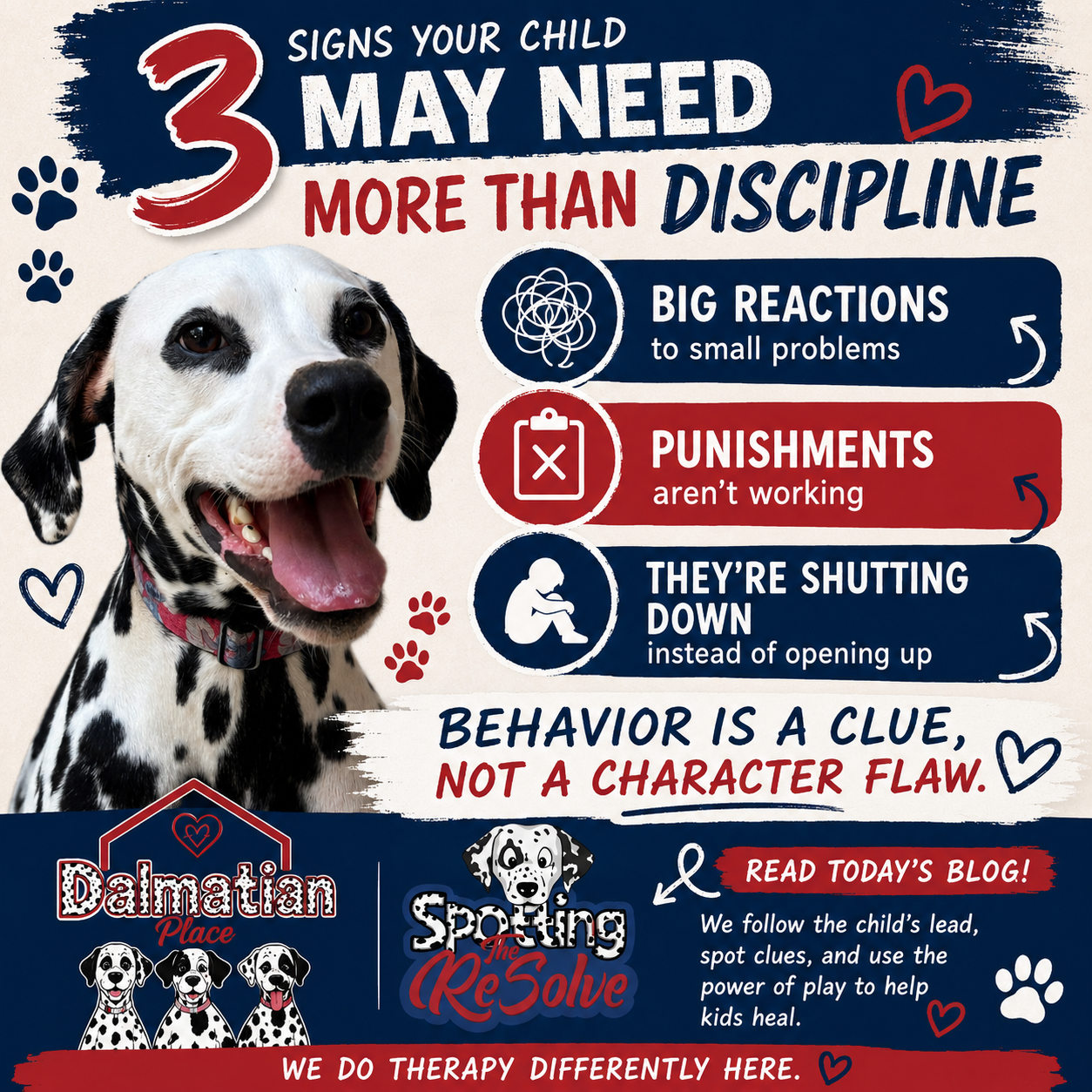
If you're reading this while hiding in the pantry after another meltdown, school phone call, bedtime battle, or sibling argument, I want you to know something:
You're not failing.
(And your child probably isn't trying to make your life difficult.)
At Dalmatian Place, we often meet parents who are exhausted.
They've tried consequences, rewards, sticker charts, taking away screens, stricter rules, gentler rules, and everything in between. NONE of it works.
What if the behavior isn't the problem?
What if it's a clue?
One of the things we say often around here is:
Behavior is a clue, not a character flaw.
Children communicate through behavior long before they have the words to explain what's happening inside.
Here are three signs your child may need more than discipline.
1. The Reaction Doesn't Match The Situation
Have you ever thought:
"Why did they react THAT strongly to something so small?"
Maybe they screamed because the wrong cup was used.
Maybe they melted down over homework.
Maybe they slammed their bedroom door after being told no.
The behavior may seem bigger than the situation because your child isn't reacting only to that moment.
Children who are overwhelmed, anxious, grieving, neurodivergent, stressed, or carrying difficult experiences often have nervous systems that are already running on empty.
That spilled milk may not be about the milk.
The missing shoe may not be about the shoe.
The reaction may be telling us that their emotional bucket is already overflowing.
2. Punishments Don't Seem To Change The Behavior
If you've found yourself saying:
"We've talked about this a hundred times."
Or:
"They know better."
You aren't alone.
When a child continues a behavior despite consequences, we have to become curious.
Not because boundaries don't matter.
They absolutely do.
But consequences teach best when children have the skills, regulation, and emotional capacity to do something different.
Many children know what they're supposed to do.
They simply can't access those skills in the moment.
That's where play therapy can help.
Instead of asking, "How do we stop this behavior?"
We ask:
"What is this behavior trying to tell us?"
3. Your Child Is Shutting Down Instead Of Opening Up
Not all struggling children have big behaviors.
Some become quiet.
Some withdraw.
Some spend more time alone.
Some stop talking about their day.
Some become anxious, worried, or emotionally flat.
Children often communicate stress through play, body language, and behavior long before they communicate it through words.
When children don't have the language to explain what's happening, play becomes their language.
That's why play therapy is so powerful.
We Do Therapy Differently Here
At Dalmatian Place, children don't sit across from an adult answering questions for fifty minutes.
We follow the child's lead.
We use play, creativity, movement, connection, and relationship to help children express what they may not yet have words for.
Because healing doesn't always happen through talking.
Sometimes it happens while building, pretending, drawing, moving, laughing, creating, and feeling safe enough to be understood.
If you're wondering whether your child might benefit from support, trust that feeling.
You know your child best.
And if things have felt hard lately, you don't have to figure it out alone.
At Dalmatian Place, we believe every behavior tells a story.
Our job is to help you and your child understand what that story might be saying.
🐾 We follow the child's lead.
🐾 We spot clues.
🐾 We believe in the power of play.
Because we do therapy differently here.
This week at Dalmatian Place, we're talking about behavior clues, connection, and helping children feel understood. On Friday, we'll continue the conversation in our Lilo & Stitch Family Dinner & a Side Dish of Therapy series, where we'll explore what belonging, attachment, and connection can teach us about raising children with big feelings.
FREE Parenting Resource
Frequently Asked Questions About Play Therapy:
How Do I Know If My Child Needs Therapy?
Many parents ask this question.
The truth is, you don't have to wait until things are falling apart.
If your child is experiencing frequent meltdowns, anxiety, emotional outbursts, difficulty adjusting to changes, school struggles, grief, trauma, or ongoing behavioral challenges, therapy can provide support before problems become bigger.
At Dalmatian Place, we believe therapy isn't about fixing children.
It's about helping children feel understood, supported, and equipped with the tools they need to thrive.
My child won't talk about their feelings. Can play therapy still help?
Absolutely. In fact, many children who come to Dalmatian Place struggle to explain what they are feeling. Play is a child's natural language. Through play, children often communicate thoughts, worries, experiences, and emotions that they cannot yet put into words.
Is play therapy just playing?
This is one of the most common questions we hear.
Play therapy is much more than playing with toys. Our Emotional Navigators (aka, Play therapists) are specially trained to understand how children communicate through play and use therapeutic interventions that help children build emotional regulation, process experiences, develop coping skills, and strengthen relationships.
To a child, it may feel like play.
To a trained play therapist, it is purposeful and meaningful therapeutic work.
What ages benefit from play therapy?
Play therapy is often most effective for children ages 3–12, although many play-based interventions can be adapted for older children and teens. Every child is unique, and we tailor our approach to meet each child where they are developmentally and emotionally. At Dalmatian Place, we find that many of our adult clients benefit and respond to play therapy!
How is Dalmatian Place different from other counseling offices?
At Dalmatian Place, children are welcomed into a space intentionally designed for them—not an adult office with a few toys added to the corner.
We believe healing happens through connection, creativity, movement, play, and feeling safe enough to be understood.
We follow the child's lead, spot clues rather than shame behaviors, and use evidence-based play therapy approaches that help children express what they may not yet have the words to say.
Our space is specifically curated with your child in mind- a BIG playroom to explore feelings, a kitchen area with a therapy bunny for the ultimate self-regulation, outdoor spaces for big movements, and a sandtray room full of all the sensory experiences you can imagine!
Do parents participate in the therapy process?
Yes! Parents are one of the most important parts of a child's support system.
While each child's treatment plan is unique, we regularly partner with parents to help them better understand their child's behaviors, strengthen connections at home, and learn tools that support growth outside of the therapy room.
Can play therapy help neurodivergent children?
Yes. Many neurodivergent children communicate, process experiences, and express emotions differently than neurotypical children. Play therapy can provide a safe and developmentally appropriate way to support emotional expression, self-regulation, relationship building, and confidence while honoring each child's unique strengths and needs. Miss Jess is certified in AutPlay, which is designed specifically for neurodivergent individuals!
What if I'm not sure whether therapy is the right next step?
That's okay. Many parents aren't sure when they first reach out.
If you're noticing ongoing struggles, feeling concerned, or simply wondering whether your child could benefit from additional support, we would be happy to talk with you. Sometimes a conversation is the best place to start.
Because every behavior tells a story—and you don't have to figure it out alone.
At Dalmatian Place in Longview, Texas, we work with children and families navigating anxiety, emotional regulation challenges, neurodivergence, trauma, grief, and behavioral concerns through child-centered play therapy.
If you're feeling exhausted, frustrated, or worried, you're not alone.
Many of the families who walk through the doors of Dalmatian Place thought they were the only ones struggling.
They weren't.
And neither are you.
5 Signs Your Child's Meltdowns May Be About More Than Behavior | Child Therapy in Longview, TX
5 Signs Your Child's Meltdowns May Be About More Than Behavior | Child Therapy in Longview, TX
5 Signs Your Child's Meltdown May Be About More Than Behavior
Wondering why your child has frequent meltdowns? Learn 5 signs your child's emotional outbursts may be about more than behavior and discover how play therapy can help.
Is your child's meltdown really about behavior—or could it be a sign of something deeper? Many parents feel frustrated, confused, or overwhelmed when their child has frequent emotional outbursts. While it's easy to focus on the behavior itself, understanding what's happening beneath the surface can make all the difference.
At Dalmatian Place Counseling & Play Therapy, we believe that behavior is communication. A meltdown is often a child's way of expressing emotions, stress, or unmet needs they don't yet have the skills or words to communicate.
In this article, we'll explore five signs that your child's meltdowns may be about more than behavior and how you can begin responding with curiosity and connection.
What if the Meltdown Isn't the Problem?
As parents, it's natural to focus on what we can see:
Tears
Yelling
Defiance
Shutting down
Aggression
Emotional explosions
But what if those behaviors are actually messages?
Sometimes a child's meltdown isn't about being difficult, manipulative, or attention-seeking. Instead, it may be a sign that something underneath the surface needs support.
Here are five signs your child's meltdowns may be about more than behavior.
1. Why Does My Child Overreact to Small Things?
Your child spills their drink and suddenly they're sobbing.
You ask them to turn off a video game and they explode.
A small disappointment turns into a major emotional storm.
When reactions seem much bigger than the event itself, it may be a sign that your child is carrying stress, anxiety, overwhelm, grief, or frustration that has been building beneath the surface.
The meltdown isn't always about what just happened. Sometimes it's about everything that happened before it.
🐾 Ask yourself:Could my child be overwhelmed rather than simply overreacting?
2. Why Does My Child Melt Down Over the Same Things?
Does your child consistently struggle with:
Transitions
Changes in routine
School mornings
Homework
Loud environments
Being told "no"
Repeated triggers often point to an underlying need rather than intentional defiance.
For some children, anxiety, sensory sensitivities, ADHD, autism, or emotional regulation challenges can make everyday situations feel much harder than they appear.
🐾 Ask yourself:What might this situation feel like from my child's perspective?
3. They Have a Hard Time Explaining What They're Feeling
After a meltdown, many children cannot tell you what happened.
You may hear:
"I don't know."
"Nothing."
"Leave me alone."
"I can't explain it."
Children often experience emotions before they have the words to describe them.
When kids don't yet have the language for what they feel, those feelings often come out through behavior.
🐾 Remember: Not being able to explain emotions doesn't mean those emotions aren't real.
4. Can Stress, Trauma, or Grief Cause Child Meltdowns?
Sometimes meltdowns begin after:
A move
Divorce or family changes
Loss of a loved one
Medical challenges
Bullying
Academic struggles
A frightening event
Changes in friendships
Children may not always talk about what is bothering them, but their behavior often tells the story.
Big emotions can show up as:
Anger
Withdrawal
Clinginess
Anxiety
Increased emotional outbursts
🐾 Ask yourself:What has my child experienced recently that may be affecting them emotionally?
5. Your Family Feels Stuck
Perhaps you've tried:
✅ Consequences
✅ Rewards
✅ Sticker charts
✅ Taking things away
✅ Having talks
✅ Reading parenting books
And yet everyone still feels frustrated, exhausted, or disconnected.
When families feel stuck, it often means the solution requires understanding what's beneath the behavior—not simply trying harder to stop it.
🐾 Sometimes children need support learning how to understand, express, and regulate their emotions in a safe environment.
Why Understanding the Root Cause Matters
When we focus only on stopping a behavior, we may miss the opportunity to understand what our child is trying to communicate.
Children who struggle with emotional regulation often benefit from:
Learning emotional vocabulary
Developing coping skills
Building self-awareness
Strengthening parent-child connection
Processing difficult experiences
Feeling understood and supported
By looking beneath the behavior, parents can respond with empathy while still maintaining healthy boundaries and expectations.
A Different Way to Look at Meltdowns
At Dalmatian Place, we believe:
❤️ Behavior is communication.
❤️ Connection is the bridge.
❤️ Every child has strengths.
❤️ Every family deserves support.
Through play therapy and trauma-informed child counseling, we help children and families understand what's beneath the behavior
How Play Therapy Helps Children with Meltdowns
Many parents wonder whether their child will simply "grow out of" emotional outbursts.
While some developmental challenges improve with age, children who struggle with frequent meltdowns often benefit from learning emotional regulation skills in a supportive environment.
At Dalmatian Place Family Therapy Center in Longview, Texas, we help children:
Understand big feelings
Develop coping skills
Improve emotional regulation
Build confidence
Strengthen family relationships
Process anxiety, grief, trauma, and life transitions
Because play is a child's natural language, play therapy allows children to communicate experiences they may not yet have words to explain.
When children feel understood, they are often better able to manage emotions, navigate challenges, and build stronger connections with the people who love them most.
Frequently Asked Questions (FAQs)
Are meltdowns normal for children?
Yes. Occasional meltdowns are a normal part of child development. Children are still learning how to manage emotions, communicate needs, and cope with frustration. However, frequent or intense meltdowns may indicate that additional support is needed.
What's the difference between a tantrum and a meltdown?
A tantrum is often goal-oriented and may stop when a child gets what they want or realizes it won't work. A meltdown is typically an emotional overload where the child feels overwhelmed and has difficulty regaining control, even if they want to.
Can anxiety cause meltdowns in children?
Absolutely. Anxiety can make everyday situations feel overwhelming and may lead to emotional outbursts, avoidance, irritability, or shutdowns. Children often express anxiety through behavior rather than words.
When should I seek counseling for my child's meltdowns?
Consider seeking professional support if meltdowns are frequent, intense, impacting daily life, affecting school or relationships, or causing significant stress for your family.
How does play therapy help with emotional regulation?
Play therapy allows children to express feelings, process experiences, and develop coping skills through play—their natural language. It can help children better understand emotions and learn healthier ways to communicate their needs.
Can parenting strategies alone solve meltdowns?
Parenting strategies are important, but if a child is struggling with anxiety, trauma, sensory challenges, ADHD, grief, or emotional regulation difficulties, additional support may be beneficial. Understanding the root cause is often key to lasting change.
You Don't Have to Figure It Out Alone.
If your child's meltdowns are leaving your family feeling overwhelmed, frustrated, or disconnected, support is available.
Let's spot what's beneath the behavior—together.
Not sure where to start?
Schedule a free consultation and we'll help you determine whether counseling, play therapy, parent support, or another service might be the best fit for your child and family.
Looking for Help with Child Meltdowns in East Texas?
Families throughout Longview, Hallsville, White Oak, Kilgore, Marshall, Gilmer, and the surrounding East Texas communities often reach out when they feel stuck in a cycle of meltdowns, emotional outbursts, anxiety, or behavior challenges. If you've tried consequences, rewards, reminders, and parenting strategies but still feel like something deeper is going on, you're not alone. At Dalmatian Place Family Therapy Place, we help children and families understand what's beneath the behavior through play-based, trauma-informed counseling that focuses on connection, emotional regulation, and lasting growth.
Dalmatian Place Counseling & Play Therapy
📞 (903) 309-3656
📧 DalmatianPlace@spottingtheresolve.com
🐾 Find Your Spots. Find Your ReSolve.