Family Dinner and a Movie (with a side dish of Therapy!)

There is just something magical about Friday nights.
The weekly chaos softens a little.
Everyone finally exhales.
And while family movie nights may seem small… these moments often become the things our children remember forever.
Not because everything was perfect.
Not because dinner looked Instagram-worthy.
But because connection happened there.
So welcome to our very first:
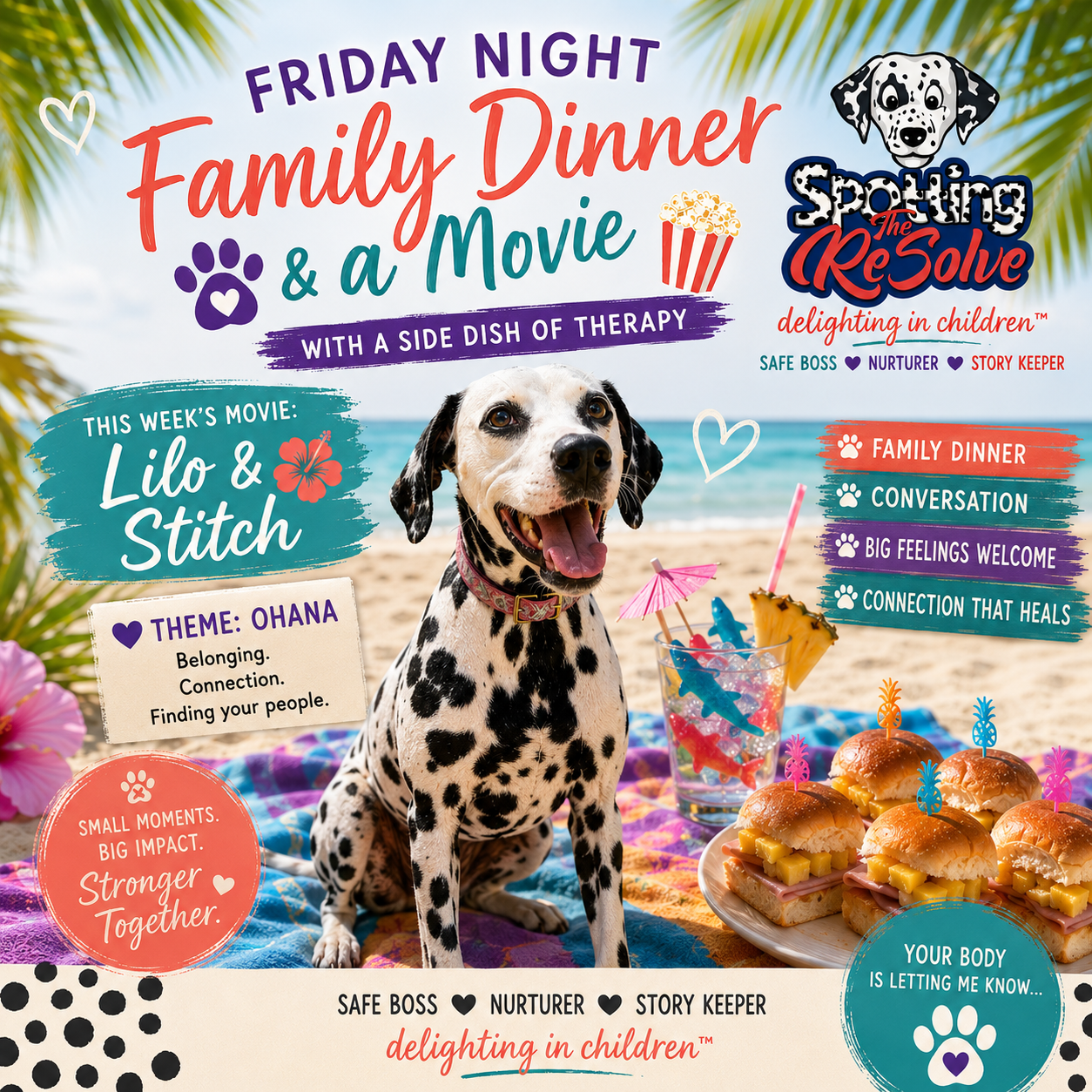
Family Dinner & a Movie Night
(….with a Side Dish of Therapy)
Where we take family movies we already love and gently explore the emotional themes hidden underneath them, all while sharing an easy dinner idea your nervous system can realistically handle after a long week.
And honestly?
For me, there was no better movie to start with than Lilo & Stitch! (and you get to pick, you can watch the original Animated version or you can go modern and watch the live-action remake from 2025).
This Week’s Movie:
Lilo & Stitch
On the surface, it is a funny movie about a chaotic blue alien destroying everything in sight.
But underneath?
It is a story about:
grief,
belonging,
emotional dysregulation,
attachment,
loneliness,
found family,
and the deep human need to feel safe with someone.
Honestly?
Stitch is what happens when trauma meets zero coping skills.
And Lilo?
Lilo is the child so many adults misunderstand. So many teachers get frazzled by. The child who often gets labeled as bad, wrong, different, or defiant. (Dare I say, the kids some places will label “Oppositional Defiant Disorder”?)
In reality though?
Lilo is :
Imaginative.
Sensitive.
Big-feeling.
Different.
Lonely.
Reactive.
And underneath all of that?
She is child that is grieving something that even seasoned adults don’t comprehend or know how to express.
For more on child emotional development, you can explore:
For trauma-informed parenting guidance, the National Child Traumatic Stress Network offers helpful resources: NCTSN
The “Side Dish of Therapy”
One of the most powerful things about this movie is that neither Lilo nor Stitch are “bad.”
They are dysregulated. There’s a BIG difference between “bad” and “dysregulated.
Children who have experienced stress, trauma, overwhelm, grief, instability, or disconnection often communicate through:
meltdowns,
aggression,
shutdowns,
clinginess,
avoidance,
defiance,
emotional chaos.
Not because they are trying to make your life harder. But because their nervous systems do not yet feel safe.
And honestly?
Adults do this too. (Just with better email etiquette and caffeine ;) )
The Therapy Takeaway:
Connection changes behavior more than shame ever will.
Throughout the movie, Stitch changes, not because someone punishes him enough…
…but because someone stays with him when things are hard.
Someone delights in him.
Someone sees beyond the behavior.
Someone becomes safe enough for him to soften.
That matters deeply for children.
Because healing often begins the moment a child realizes:
“Maybe I am not too much after all.”
🍍 Dinner Plan:
Hawaiian Sheet Pan Sliders
Prep Time: 10 minutes
Cook Time: 15 minutes
Serves: 4–6
Ingredients
1 package Hawaiian sweet rolls (12-count)
12 slices deli ham or turkey
6 slices Swiss, provolone, or mozzarella cheese
4 tablespoons butter, melted
1 teaspoon garlic powder
1 teaspoon Italian seasoning
Optional: pineapple rings cut into small pieces
Directions
Step 1:
Preheat oven to 350°F.
Step 2:
Without separating the rolls, slice the entire package in half horizontally.
Step 3:
Place the bottom half of the rolls on a sheet pan or baking dish.
Step 4:
Layer:
ham or turkey
cheese
pineapple pieces (optional)
Step 5:
Place the top half of the rolls back on.
Step 6:
Mix melted butter, garlic powder, and Italian seasoning.
Brush generously over the tops.
Step 7:
Cover loosely with foil and bake for 10 minutes.
Remove the foil and bake for another 5 minutes, until golden and melty.
Step 8:
Cut into individual sliders and serve.
Ohana Fruit Kabobs
Because every movie night needs something colorful.
Ingredients
Pineapple chunks
Strawberries
Blueberries
Grapes
Wooden skewers
Directions:
Let kids build their own kabobs.
Try alternating colors:
🍍 Pineapple
🍓 Strawberry
🫐 Blueberry
🍇 Grape
Repeat until the skewer is full.
(A fun side of therapy, make each color of fruit a different emotion and have kids build their kabobs to reflect their feelings over the week!)
Pineapple Ocean Mocktail
Ingredients
1 cup pineapple juice
½ cup lemon-lime soda or sparkling water
Splash blue sports drink or blue raspberry syrup
Ice
Optional: pineapple wedge, shark gummies, and tiny umbrellas
Directions
Fill cup with ice.
Pour:
pineapple juice first
blue drink second
soda last
Watch the colors swirl together like an ocean.
Add a tiny umbrella and shark gummies for bonus movie-night points.
🍍🐾 Bonus Spot of Joy
Pineapple Upside-Down Cake
1 box Pineapple Supreme Cake Mix
Ingredients called for on the box
1 can pineapple rings
Maraschino cherries
Frosting, white or cream cheese.
Directions
Step 1
Follow the directions on the box of cake mix.
Step 2
After the cake cools, frost with frosting of choice
Step 3
Decorate with pineapple rings and Maraschino cherries.
🐾 Spotting the ReSolve Family Challenge
During dinner, ask:
"What helps you feel like you belong?"
There are no wrong answers.
Some children will answer immediately.
Some will shrug.
Some will say:
"I don't know."
That's okay.
You can simply respond:
"Hmm. We can wonder about it together."
Sometimes safety begins when children discover they don't need the right answer.
Sometimes they just need someone willing to stay at the table with them while they figure it out.
And honestly?
That might be the most important ingredient in the whole meal.
Family Conversation Starters
(Keep it light. This is connection time — not an interrogation.)
Try:
“Which character felt misunderstood?”
“What do you think Stitch needed most?”
“Which part made you laugh the hardest?”
“What helps YOU feel safe when upset?”
“Who helped Stitch feel like he belonged?”
“What do you think Lilo needed from the grown-ups around her?”
🤍 And If Your Child Says:
“I don’t know.”
First:
Take a deep breath and resist the urge to immediately rephrase the question seventeen different ways.
“I don’t know” is often not a refusal.
It is protection.
Sometimes, children genuinely do not yet have the words for what they are feeling.
Sometimes their body does not feel safe enough to answer.
Sometimes they are still processing internally.
And sometimes direct questions can feel surprisingly vulnerable — especially for children carrying anxiety, trauma, shame, or overwhelm.
So instead of pushing harder, we shift to creating safety.
🐾 Becoming a “Safe Boss”
In TraumaPlay, we talk about becoming a Safe Boss.
Not scary boss.
Not a controlling boss.
Safe Boss.
A calm, regulated adult who helps a child’s nervous system know:
“You are safe with me.”
That can sound like:
“You don’t have to answer right away.”
“We can just wonder together.”
“Your body is letting me know this question might feel big.”
“It is okay if you don’t have words yet.”
“You’re not in trouble.”
“I like hearing your thoughts whenever you’re ready.”
Safety lowers defenses.
Pressure raises them.
🌺 The Power of a “Nurturer”
Children open up most when they feel emotionally received — not evaluated.
That means slowing down enough to:
sit beside them,
stay playful,
soften your tone,
and genuinely delight in who they are.
Not just in their “good behavior.”
But in them.
Sometimes the most healing thing a child experiences is an adult who:
laughs with them,
notices them,
stays calm,
and enjoys being with them without trying to fix them.
That is nurturer energy.
And children feel it deeply.
📖 Becoming a “Story Keeper”
Many children process experiences sideways before they process them directly.
So instead of:
“Tell me what you learned from the movie.”
Try:
“I wonder if Stitch felt lonely there.”
“That part seemed really big.”
“His body looked really overwhelmed.”
“I noticed Lilo kept trying to stay connected.”
This helps children borrow your nervous system and emotional language safely.
You are not forcing disclosure.
You are becoming a gentle story keeper:
Someone who helps organize emotional experiences into something understandable and safe.
And often?
That is when children begin talking naturally on their own.
Usually while staring at the ceiling.
Or holding a mozzarella stick.
Or five minutes after the conversation supposedly ended.
🌊 One Final Thought:
Ohana, Emotional Safety, and the Power of Staying
At the heart of Lilo and Stitch is a message children don’t always hear enough:
You do not have to be easy to love to be loved.
And for parents, the reminder is just as powerful:
You are not raising perfect behavior.
You are raising emotional safety.
And sometimes, the best therapy session is a couch, a movie, and a willingness to talk about what feelings showed up in the room.
Because in the end…
Ohana really does mean nobody gets left behind—or forgotten.
The famous line from the movie says:
“Ohana means family. Family means nobody gets left behind or forgotten.”
And while real families are imperfect and messy and human…..
The deeper truth underneath that line is this:
People heal in safe connection.
Not perfection.
And sometimes healing looks less like a huge breakthrough…
…and more like sitting on the couch together, drinking pineapple mocktails while a tiny blue alien learns he is worthy of love.
Honestly?
That counts too.
FAQS:
Is Lilo & Stitch appropriate for toddlers and young children?
For most children, yes. Lilo & Stitch is generally family-friendly, but parents should know that it includes some emotionally intense themes, including grief, family separation, loss, and big behaviors. Younger children may not fully understand these themes, but they often connect with the feelings underneath them.
Watching together gives you the opportunity to pause, answer questions, and help children process what they are seeing. Some of the best conversations happen when we sit beside our children and experience the story with them.
What is the main lesson kids learn from Lilo & Stitch?
At its heart, Lilo & Stitch is a story about belonging.
Children learn that family is more than perfection. Family is connection, safety, repair, and showing up for one another. The famous phrase, "Ohana means family," reminds us that everyone deserves a place where they feel loved, accepted, and valued—even when they make mistakes.
It is also a beautiful story about attachment, emotional regulation, and discovering that we do not have to earn our place in the hearts of people who love us.
Why does Stitch act out and what can kids learn from his behavior?
Stitch spends much of the movie making poor choices, acting impulsively, and creating chaos wherever he goes.
From a therapy perspective, Stitch is a wonderful example of how behavior often communicates unmet needs. He begins the story feeling disconnected, misunderstood, and alone. As he experiences safety, connection, and belonging, his behavior begins to change.
One of the most important lessons children can learn is that people are often more than their worst moments. Connection helps create change far more effectively than shame.
Can Lilo & Stitch help children learn about emotions?
Absolutely.
The movie gives children opportunities to talk about sadness, loneliness, frustration, fear, love, and belonging in a way that feels safe and indirect. Sometimes children find it easier to talk about a character's feelings before they talk about their own.
You might ask:
How do you think Stitch felt in that moment?
What do you think Lilo needed?
Have you ever felt left out like that?
Stories often help children build emotional language and self-awareness without feeling pressured.
How do I talk to my child about sadness or anger after watching this movie?
Start with curiosity instead of correction.
Rather than saying:
"Don't be sad."
Try:
"That seemed like a really big moment."
Or:
"Your body is letting me know that part felt important."
Children do not need us to fix every feeling. They need us to help them feel safe while experiencing those feelings.
Simple questions like:
What stood out to you?
Which character felt misunderstood?
What helped Stitch feel better?
can open meaningful conversations without making children feel interrogated.
What does "Ohana means family" actually teach children emotionally?
Emotionally, the message of Ohana is about belonging.
Children thrive when they know:
I matter.
I am safe.
I am loved.
I am accepted.
I can make mistakes and still be connected.
Ohana teaches children that family is not about being perfect. It is about staying connected through life's hard moments and helping one another feel seen, valued, and understood.
Are there any sensitive themes in Lilo & Stitch parents should know about?
Yes.
The movie includes themes of:
Grief and loss
Family separation
Foster care concerns
Feeling different or misunderstood
Emotional dysregulation
Conflict between siblings
Most children tolerate these themes well, especially when watching with a supportive adult. For some children who have experienced significant loss, separation, trauma, or adoption-related experiences, these scenes may bring up bigger feelings and may benefit from additional conversation and support.
What activities can I do with my child after watching Lilo & Stitch?
Some of our favorite activities include:
Create an Ohana Spot Tree
Write the names of safe people, favorite memories, and coping skills on Dalmatian spots and add them to a family tree.
Draw a Stitch Moment
Ask your child to draw a time when they felt misunderstood and what helped them feel better.
Build a Coping Skills Surfboard
Write calming tools, safe people, and helpful strategies on a paper surfboard.
Family Conversation Cards
Use movie-inspired questions to explore belonging, friendship, emotions, and family connection.
Spot the Helpers
Talk about the people in the movie who helped others feel safe, supported, and loved.
These activities help children practice emotional awareness while creating meaningful family connection.
At Spotting the ReSolve, we believe happens in everyday moments too — through play, safety, nervous system support, connection, laughter, and being fully seen.
Follow along for more:
🍿 movie nights
🐾 therapy insights
💜 nervous system-friendly parenting ideas
🌺 and practical ways to connect as a family without making everything feel like homework.
Keep the Connection Going ❤️🐾
If tonight reminded you how much your child wants to connect—but you're still navigating meltdowns, anxiety, emotional outbursts, grief, trauma, or big feelings—you don't have to figure it out alone.
AtDalmatian Place, we believe behavior is a clue, not a character flaw.
Through play therapy, parent support, and neurodiversity-affirming care, we help children feel safe enough to express what's happening beneath the behavior... and help parents feel confident enough to respond with connection rather than confusion.
Because healing doesn't happen by becoming a "perfect" parent.
It happens one safe relationship at a time.
🐾 Ready to take the next step?
I'd love to meet your family.
Dalmatian Place
Family Therapy in Longview
📍 Longview, Texas
📞 (903) 309-3656
✉️ Jessica@spottingtheresolve.com
Until next time,
Keep spotting the little moments,
Because every child deserves someone who delights in them!
