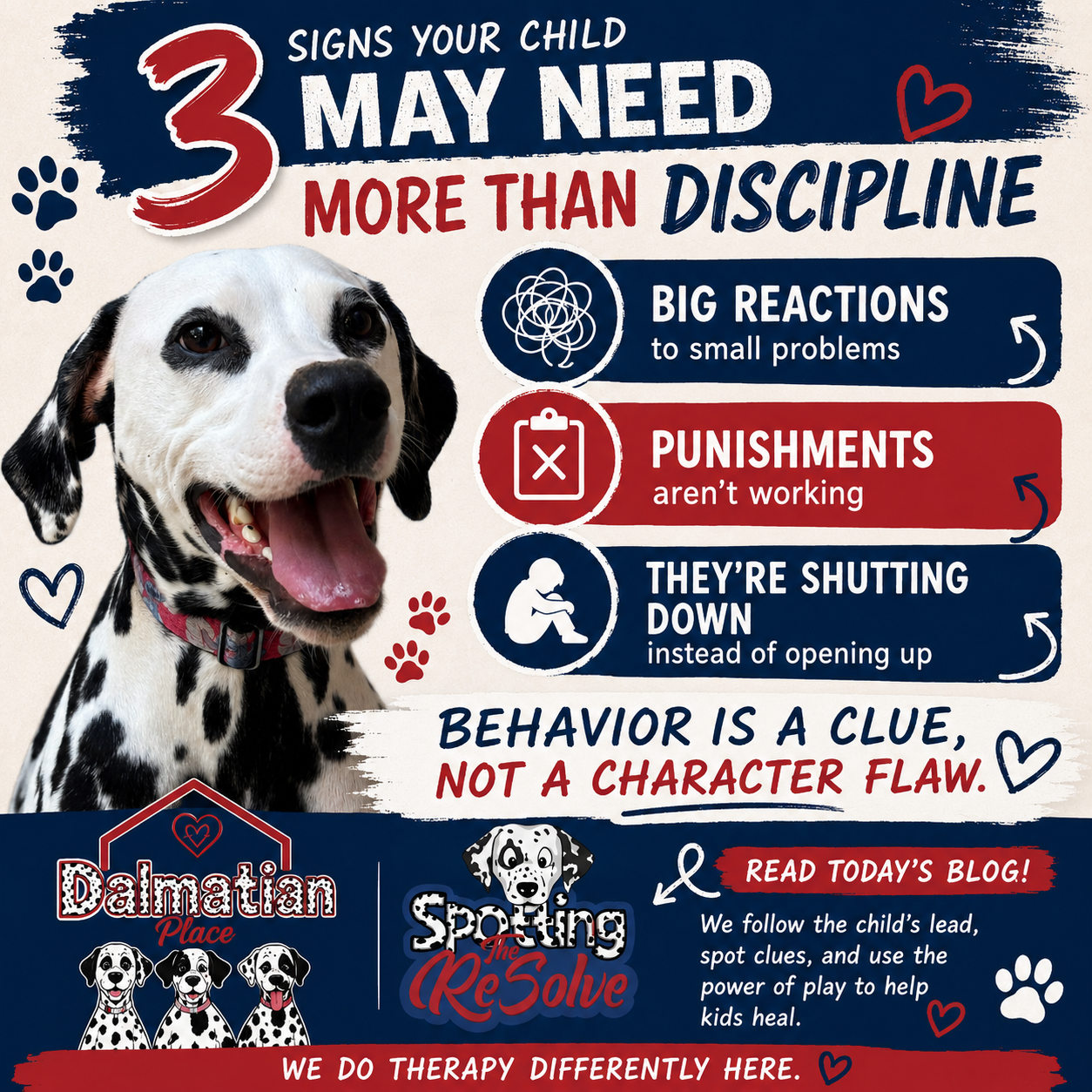
3 Signs Your Child May Need More Than Discipline (And Why Their Behavior Might Be Telling You Something Important)
If you're reading this while hiding in the pantry after another meltdown, school phone call, bedtime battle, or sibling argument, I want you to know something:
You're not failing.
(And your child probably isn't trying to make your life difficult.)
At Dalmatian Place, we often meet parents who are exhausted.
They've tried consequences, rewards, sticker charts, taking away screens, stricter rules, gentler rules, and everything in between. NONE of it works.
What if the behavior isn't the problem?
What if it's a clue?
One of the things we say often around here is:
Behavior is a clue, not a character flaw.
Children communicate through behavior long before they have the words to explain what's happening inside.
Here are three signs your child may need more than discipline.
1. The Reaction Doesn't Match The Situation
Have you ever thought:
"Why did they react THAT strongly to something so small?"
Maybe they screamed because the wrong cup was used.
Maybe they melted down over homework.
Maybe they slammed their bedroom door after being told no.
The behavior may seem bigger than the situation because your child isn't reacting only to that moment.
Children who are overwhelmed, anxious, grieving, neurodivergent, stressed, or carrying difficult experiences often have nervous systems that are already running on empty.
That spilled milk may not be about the milk.
The missing shoe may not be about the shoe.
The reaction may be telling us that their emotional bucket is already overflowing.
2. Punishments Don't Seem To Change The Behavior
If you've found yourself saying:
"We've talked about this a hundred times."
Or:
"They know better."
You aren't alone.
When a child continues a behavior despite consequences, we have to become curious.
Not because boundaries don't matter.
They absolutely do.
But consequences teach best when children have the skills, regulation, and emotional capacity to do something different.
Many children know what they're supposed to do.
They simply can't access those skills in the moment.
That's where play therapy can help.
Instead of asking, "How do we stop this behavior?"
We ask:
"What is this behavior trying to tell us?"
3. Your Child Is Shutting Down Instead Of Opening Up
Not all struggling children have big behaviors.
Some become quiet.
Some withdraw.
Some spend more time alone.
Some stop talking about their day.
Some become anxious, worried, or emotionally flat.
Children often communicate stress through play, body language, and behavior long before they communicate it through words.
When children don't have the language to explain what's happening, play becomes their language.
That's why play therapy is so powerful.
We Do Therapy Differently Here
At Dalmatian Place, children don't sit across from an adult answering questions for fifty minutes.
We follow the child's lead.
We use play, creativity, movement, connection, and relationship to help children express what they may not yet have words for.
Because healing doesn't always happen through talking.
Sometimes it happens while building, pretending, drawing, moving, laughing, creating, and feeling safe enough to be understood.
If you're wondering whether your child might benefit from support, trust that feeling.
You know your child best.
And if things have felt hard lately, you don't have to figure it out alone.
At Dalmatian Place, we believe every behavior tells a story.
Our job is to help you and your child understand what that story might be saying.
🐾 We follow the child's lead.
🐾 We spot clues.
🐾 We believe in the power of play.
Because we do therapy differently here.
This week at Dalmatian Place, we're talking about behavior clues, connection, and helping children feel understood. On Friday, we'll continue the conversation in our Lilo & Stitch Family Dinner & a Side Dish of Therapy series, where we'll explore what belonging, attachment, and connection can teach us about raising children with big feelings.
FREE Parenting Resource
Frequently Asked Questions About Play Therapy:
How Do I Know If My Child Needs Therapy?
Many parents ask this question.
The truth is, you don't have to wait until things are falling apart.
If your child is experiencing frequent meltdowns, anxiety, emotional outbursts, difficulty adjusting to changes, school struggles, grief, trauma, or ongoing behavioral challenges, therapy can provide support before problems become bigger.
At Dalmatian Place, we believe therapy isn't about fixing children.
It's about helping children feel understood, supported, and equipped with the tools they need to thrive.
My child won't talk about their feelings. Can play therapy still help?
Absolutely. In fact, many children who come to Dalmatian Place struggle to explain what they are feeling. Play is a child's natural language. Through play, children often communicate thoughts, worries, experiences, and emotions that they cannot yet put into words.
Is play therapy just playing?
This is one of the most common questions we hear.
Play therapy is much more than playing with toys. Our Emotional Navigators (aka, Play therapists) are specially trained to understand how children communicate through play and use therapeutic interventions that help children build emotional regulation, process experiences, develop coping skills, and strengthen relationships.
To a child, it may feel like play.
To a trained play therapist, it is purposeful and meaningful therapeutic work.
What ages benefit from play therapy?
Play therapy is often most effective for children ages 3–12, although many play-based interventions can be adapted for older children and teens. Every child is unique, and we tailor our approach to meet each child where they are developmentally and emotionally. At Dalmatian Place, we find that many of our adult clients benefit and respond to play therapy!
How is Dalmatian Place different from other counseling offices?
At Dalmatian Place, children are welcomed into a space intentionally designed for them—not an adult office with a few toys added to the corner.
We believe healing happens through connection, creativity, movement, play, and feeling safe enough to be understood.
We follow the child's lead, spot clues rather than shame behaviors, and use evidence-based play therapy approaches that help children express what they may not yet have the words to say.
Our space is specifically curated with your child in mind- a BIG playroom to explore feelings, a kitchen area with a therapy bunny for the ultimate self-regulation, outdoor spaces for big movements, and a sandtray room full of all the sensory experiences you can imagine!
Do parents participate in the therapy process?
Yes! Parents are one of the most important parts of a child's support system.
While each child's treatment plan is unique, we regularly partner with parents to help them better understand their child's behaviors, strengthen connections at home, and learn tools that support growth outside of the therapy room.
Can play therapy help neurodivergent children?
Yes. Many neurodivergent children communicate, process experiences, and express emotions differently than neurotypical children. Play therapy can provide a safe and developmentally appropriate way to support emotional expression, self-regulation, relationship building, and confidence while honoring each child's unique strengths and needs. Miss Jess is certified in AutPlay, which is designed specifically for neurodivergent individuals!
What if I'm not sure whether therapy is the right next step?
That's okay. Many parents aren't sure when they first reach out.
If you're noticing ongoing struggles, feeling concerned, or simply wondering whether your child could benefit from additional support, we would be happy to talk with you. Sometimes a conversation is the best place to start.
Because every behavior tells a story—and you don't have to figure it out alone.
At Dalmatian Place in Longview, Texas, we work with children and families navigating anxiety, emotional regulation challenges, neurodivergence, trauma, grief, and behavioral concerns through child-centered play therapy.
If you're feeling exhausted, frustrated, or worried, you're not alone.
Many of the families who walk through the doors of Dalmatian Place thought they were the only ones struggling.
They weren't.
And neither are you.
