Inside Out 2 Family Dinner and a Movie—with a Side Dish of Therapy 🧠🍿🐾
Teen Edition: Spotting Anxiety Beneath the Behavior
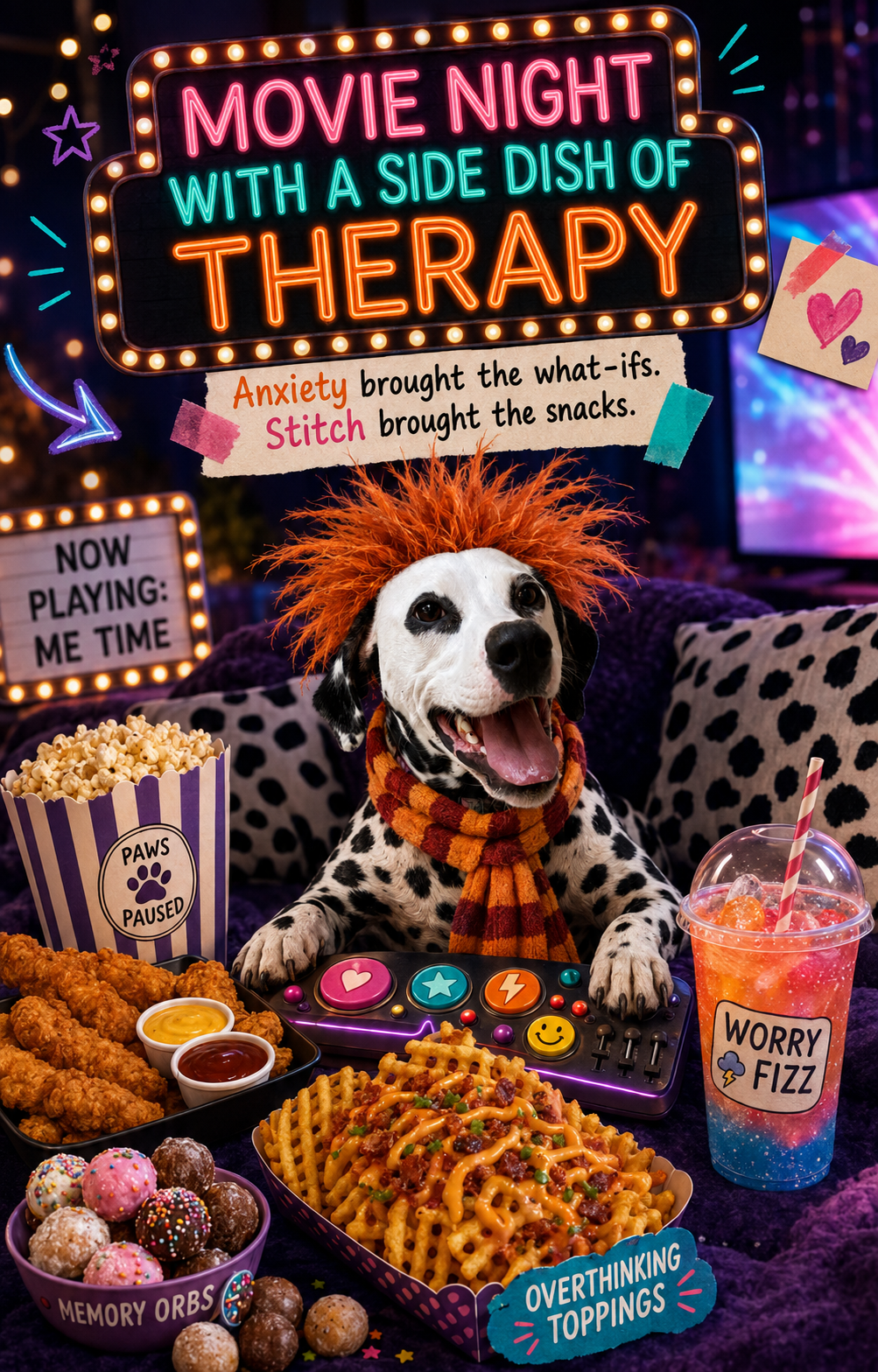
Teen movie night—without having to plan a thing! 🎬
I’m giving you:
🍗 A teen-approved dinner
🍟 Loaded waffle fries
🍩 A playful dessert
🥤 An Anxiety-inspired mocktail
🛒 A handy-dandy shopping list
💬 Conversation starters that do not feel like an interrogation
🐾 Stitch’s PAWS Plan for anxious moments
You grab the groceries, gather your teen, press play, and show up.
Because therapy can look like loaded waffle fries, colorful drinks, laughing on the couch, and one unexpectedly honest conversation.
It can be playful, practical, and wonderfully spotted.
At Dalmatian Place, we believe that therapy done differently, definitely not beige or basic. 💕🐾
Tonight’s Feature:
Inside Out 2 🎬
In Inside Out 2, Riley’s emotional Headquarters gets a renovation, and Anxiety arrives ready to take control of the console.
Honestly? That feels remarkably accurate.
Adolescence brings changing friendships, academic expectations, social pressure, questions about identity, worries about the future, and a brain that is still under construction.
Anxiety may believe it is protecting your teen by predicting every possible problem before it happens.
But here is the tricky part:
Teen anxiety does not always look anxious.
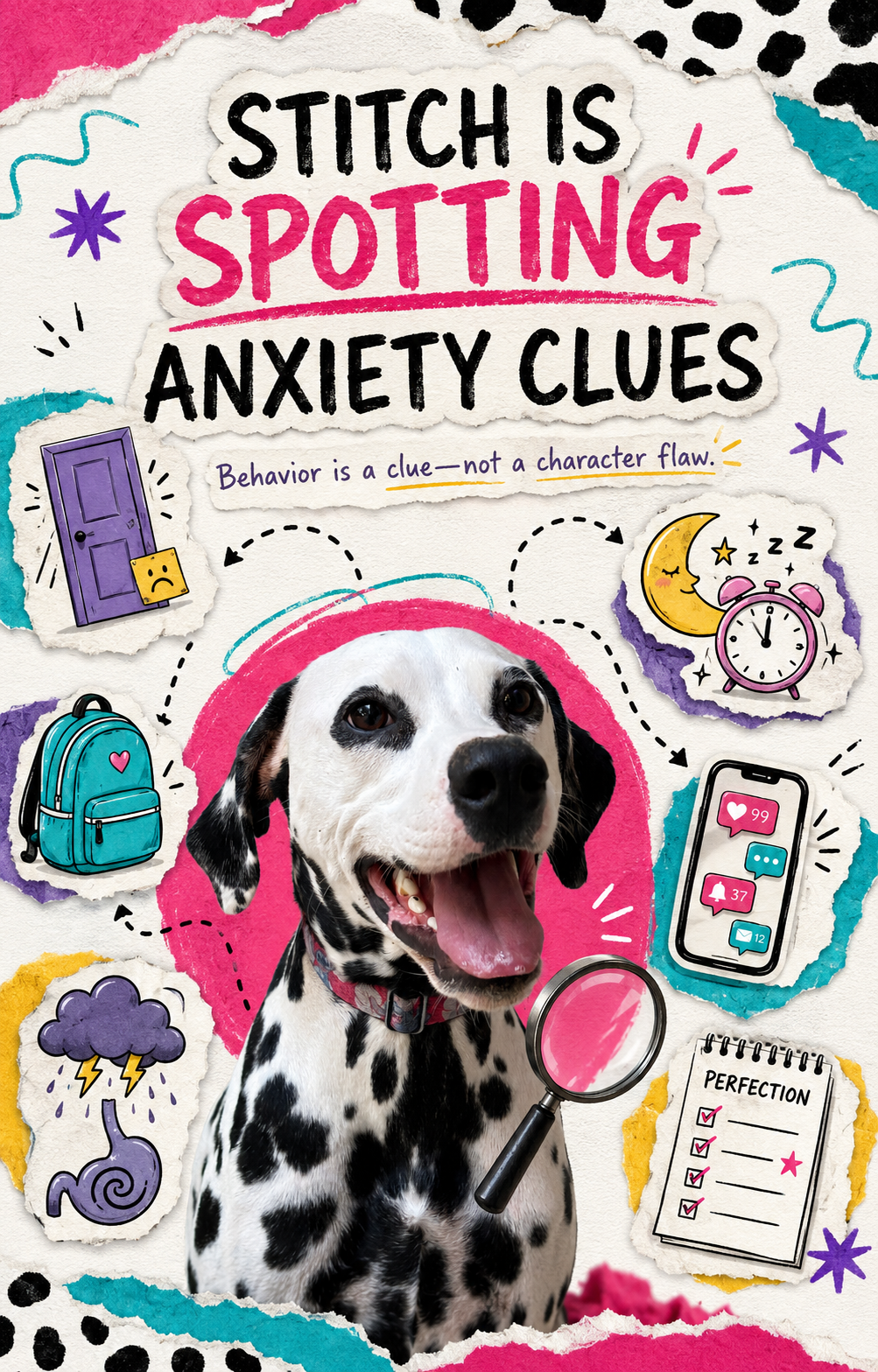
It may look like:
🐾 Irritability or snapping over small questions
🐾 Staying in a bedroom for hours
🐾 Avoiding school, friends, sports, or activities
🐾 Perfectionism followed by procrastination
🐾 Headaches, stomachaches, or constant exhaustion
🐾 Obsessing over something they said or did
🐾 Refusing to try because failing feels unbearable
🐾 Saying “I don’t care” when they care very deeply
🐾 Holding everything together at school and unraveling at home
At Dalmatian Place, we believe behavior is a clue, not a character flaw.
Tonight is an opportunity to spot some of those clues without putting your teenager under an emotional microscope. 🔎🐾
Before You Press Play:
(and this is the most important thing to remember!)
This is Connection, Not an Interrogation
This is not a family meeting disguised as movie night.
You do not need to pause the movie whenever Anxiety appears, analyze your teen’s behavior, or ask 47 bajilion questions while holding intense eye contact.
That is a fairly reliable way to make a teenager disappear. 😬
Keep it casual.
Eat together. Laugh together. Make observations about the characters before making anything about your teen. Let the conversation wander naturally.
Your teen may talk:
During the movie
While helping clean up
Later in the car
Through a text message
Three days from now, when you least expect it
Connection does not have to happen on command to count. 💛
Dinner Menu 🍽️
Headquarters Chicken Fingers 🍗
Keep this delightfully simple.
Use your family’s favorite frozen chicken fingers (we include a gluten-free option in my house!), or make your own from scratch if that brings you joy.
(It does not bring me additional joy on movie night, so the freezer aisle is invited to participate. 😉)
Bake or air-fry the chicken fingers according to the package directions. Then create an emotion-inspired dipping-sauce lineup:
💛 Joy: Honey mustard
💙 Sadness: Ranch or blue cheese
❤️ Anger: Buffalo sauce
💚 Disgust: Avocado ranch or green goddess dressing
💜 Fear: Barbecue sauce
🧡 Anxiety: Spicy ranch, because she adds extra zing to everything
🖤 Ennui: Whatever sauce is already open—because…effort
Invite everyone to choose the sauce that best matches their current mood, or the emotion that has spent the most time at their console this week.
No explanation required.
Loaded Emotional Baggage Waffle Fries 🍟
If adolescence comes with emotional baggage, ours should at least be covered in cheese.
Ingredients
1 large bag of frozen waffle fries
2 cups shredded cheddar or Mexican-blend cheese
Cooked, crumbled bacon
Sliced green onions
Diced tomatoes
Sour cream
Ranch dressing
Pickled jalapeños, optional
Guacamole, optional
Directions
Bake or air-fry the waffle fries until extra crispy.
Spread them on an oven-safe tray.
Sprinkle with cheese and bacon.
Return them to the oven for 3–5 minutes, or until the cheese melts.
Add green onions and tomatoes.
Set out the remaining toppings and let everyone load their own fries.
There is no correct emotional-support waffle fry!
Different nervous systems need different toppings. 🐾
🍪 DESSERT: Make Your Own Emotion Cookie Pizza
I think this is more fun than doing another sundae bar.
Bake a large GF sugar-cookie crust (boxed GF cookie mix is absolutely encouraged).
Spread with vanilla cream-cheese frosting.
Then create sections for each emotion:
💛 Joy: Pineapple + yellow sprinkles
💙 Sadness: Blueberries
❤️ Anger: Strawberries + red candies
💚 Disgust: Kiwi
🧡 Anxiety: Mandarin oranges
🩷 Embarrassment: Raspberries
💜 Ennui: Purple grapes
Let everyone decorate their own slice—or make one giant Headquarters "emotion wheel."
Anxiety’s Fizzy Forecast Mocktail 🥤⚡
Anxiety is always trying to predict the future, so this drink changes color as the forecast shifts.
For Each Drink
½ cup pink lemonade
¼ cup white cranberry juice
½ cup lemon-lime sparkling water
1–2 teaspoons blue raspberry syrup
Ice
Fresh berries or gummy candy
Sour candy strips, optional
Directions
Fill a clear glass with ice.
Add the pink lemonade and white cranberry juice.
Slowly pour in the sparkling water.
Add a small drizzle of blue raspberry syrup.
Watch the emotional forecast swirl.
Garnish with berries, gummy candy, or a sour candy strip.
As the colors move you could casually ask, if you just need to make conversation, lol:
Does anxiety ever change the forecast in your head before you know what is actually going to happen?
Inside Out 2 Conversation Starters for Teens 💬
Choose only two or three questions.
You do not need to complete the whole list, and your teen does not need to answer every question.
Easy Openers
Which emotion would be the hardest to have running Headquarters?
Which emotion was the funniest?
Which character understood Riley best?
If you could add one emotion to the movie, what would it be?
Which emotion would be most likely to steal your phone charger?
Which emotion would be the worst driver? 🚗
Spotting Anxiety
What was Anxiety trying to protect Riley from?
When did Anxiety’s help become unhelpful?
Was Anxiety the villain—or an emotion whose volume became too loud?
Why do you think anxiety sometimes looks like anger?
What might “I don’t care” actually mean?
How can you tell when normal nervousness has started taking over the console?
What kinds of situations make teenagers feel pressured to become a different version of themselves?
Looking Beneath the Behavior
Begin by talking about Riley or teenagers in general, rather than immediately asking your teen to disclose personal information.
What might be underneath a teen saying, “Leave me alone”?
Why might someone avoid something that matters to them?
Can perfectionism and procrastination come from the same fear?
Why do some teens fall apart at home after holding it together all day?
What do adults often misunderstand about teenage anxiety?
Why might someone appear angry when they actually feel scared or overwhelmed?
Questions That Build Connection:
What helps you feel supported without feeling smothered?
When you are overwhelmed, would you rather have space, help, distraction, food, or quiet company?
What is one phrase adults say that makes stress worse?
What would you rather hear?
How can I let you know I am available without pressuring you to talk?
If Anxiety is at the console, how can I help without grabbing the controls from you?
Try This: Design Your Headquarters Console 🎨🧠
Give everyone a sheet of paper and invite them to create their own emotional control panel.
Add:
🔘 A button that lowers the volume on anxious thoughts
🔘 A switch for asking for space
🔘 A person you can contact when everything feels too loud
🔘 A sensory tool that helps your body settle
🔘 A song, phrase, or activity that helps you reconnect
🔘 An “I need support, but I cannot explain it yet” button
🔘 One completely ridiculous button—because every nervous system deserves confetti
Parents, make one too.
Teens are often more willing to participate when they are invited into a shared experience instead of becoming the experience.
Stitch’s PAWS Plan for Anxious Moments 🐾
When Anxiety takes over the console, remember PAWS:
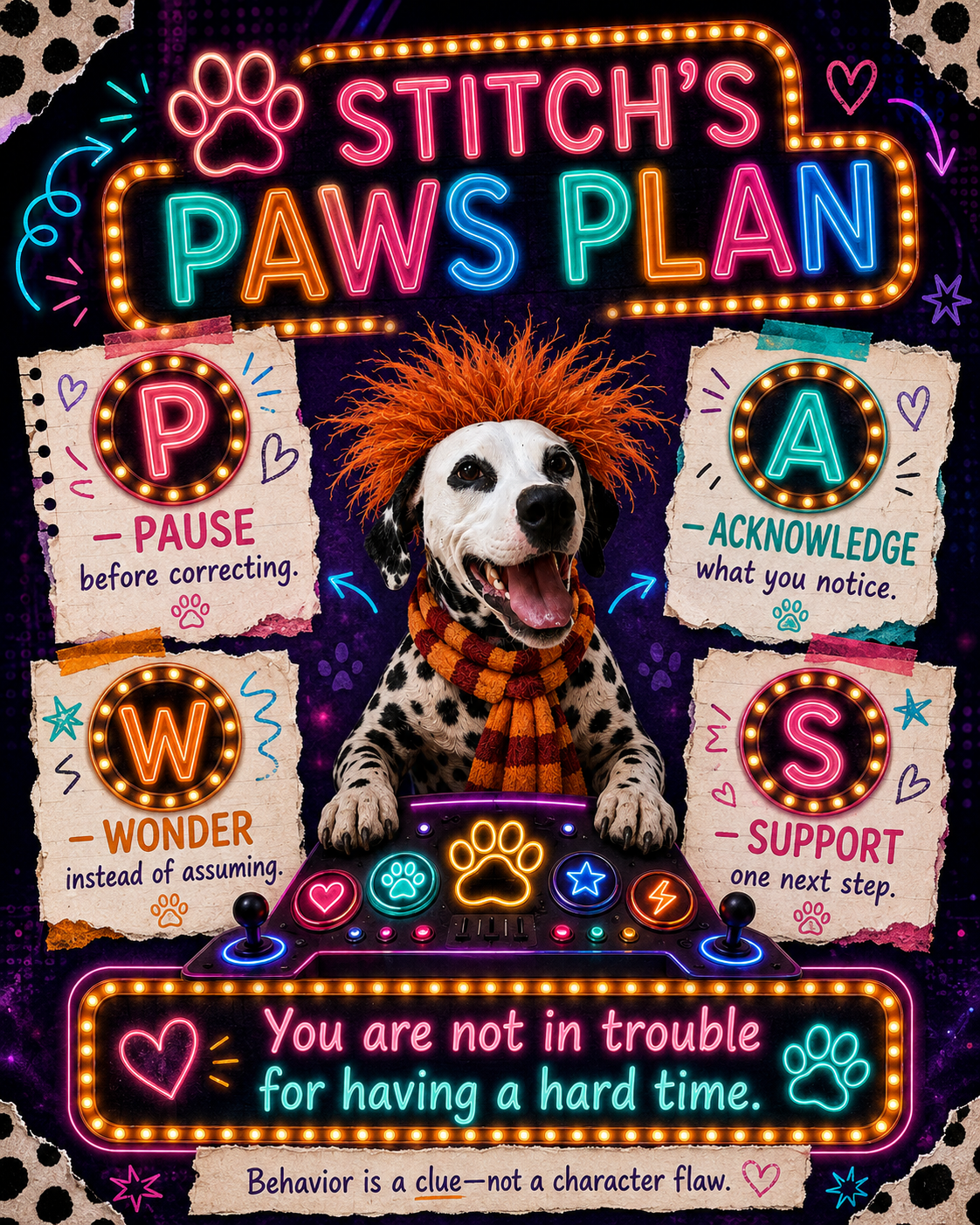
P — Pause Before Correcting
Take a breath and lower your own emotional volume before responding.
A — Acknowledge What You Notice
Try:
“You seem really overwhelmed right now.”
W — Wonder Instead of Assuming
Try:
“I wonder if this feels bigger or harder than it looks from the outside.”
S — Support One Next Step
Try:
“Would you like space, help making a plan, or quiet company?”
One especially helpful reminder is:
“You are not in trouble for having a hard time. We can figure out the next step together.”
What Not to Say to an Anxious Teen 🚫
Instead of:
“Calm down.”
“You’re overreacting.”
“There is nothing to worry about.”
“Just stop thinking about it.”
“Why are you being so difficult?”
“You have no reason to be stressed.”
Try:
“Your body seems to be sounding an alarm.”
“What part feels hardest right now?”
“Would you like help, space, or company?”
“We do not have to solve everything tonight.”
“Let’s focus on the next small step.”
“I believe you. This feels real, even if I see it differently.”
When Teen Anxiety Needs More Than Movie Night
Some anxiety is a normal part of adolescence. Additional support may be helpful when anxiety:
Interferes with school, sleep, eating, relationships, or daily activities
Causes frequent headaches, stomachaches, or physical complaints
Leads to significant avoidance or isolation
Creates ongoing conflict at home
Prevents your teen from participating in things they value
Results in frequent panic, shutdowns, or emotional outbursts
Appears to be growing stronger
Leaves your teen—or your entire family—feeling stuck
A movie night can open the door, but your family does not have to navigate everything alone.
FAQs about Teen Anxiety 🐾
Does My Teen Have to Look Worried to Be Experiencing Anxiety?
No. Teen anxiety frequently hides beneath irritability, anger, withdrawal, perfectionism, physical complaints, procrastination, exhaustion, or avoidance.
Some teenagers look calm outside the home but unravel when they reach the safety of their family.
The behavior may be the first clue that their nervous system is overwhelmed.
Is Teen Anxiety Just a Normal Part of Adolescence?
Some worry, stress, and self-consciousness are expected during adolescence.
However, anxiety may need professional support when it becomes intense, persistent, difficult to manage, or begins interfering with school, sleep, relationships, health, activities, or everyday family life.
What if My Teen Refuses to Talk About Their Feelings?
Do not force the conversation.
Teens may communicate more comfortably while driving, cooking, walking, playing a game, caring for an animal, creating something, or sitting beside you instead of directly across from you.
Begin with curiosity and connection—not interrogation.
A parent consultation can also help you learn ways to support your teen even if they are not ready to talk.
What if My Teen Says Therapy Will Be Awkward?
That concern makes sense. Many teens imagine therapy as sitting in a beige office while an unfamiliar adult repeatedly asks how they feel.
At Dalmatian Place, therapy is done differently.
We may use creativity, games, movement, animals, humor, shared interests, nervous-system education, or practical problem-solving to create a space where teens can connect without being forced to perform vulnerability.
Is Anxiety Different for Neurodivergent Teens?
It can be.
Autistic, ADHD, gifted, twice-exceptional, and otherwise neurodivergent teens may experience anxiety connected to sensory overload, masking, executive-functioning demands, social uncertainty, rejection sensitivity, transitions, burnout, or feeling chronically misunderstood.
Support should be individualized, neurodivergent-affirming, and focused on understanding the nervous system beneath the behavior.
Do Parents Participate in Teen Therapy?
Parent involvement depends on the teen’s age, needs, treatment goals, and clinical circumstances.
Parents remain important members of the support system. Therapy may include parent consultations, practical strategies, help recognizing anxiety clues, and ways to strengthen connection while respecting the teen’s growing need for privacy and autonomy.
When Should I Seek Immediate Help?
Take any mention of suicide, self-harm, hopelessness, or not wanting to be alive seriously.
In the United States, call or text 988 for the Suicide & Crisis Lifeline. If your teen may be in immediate danger, call 911or go to the nearest emergency department.
Are You Spotting Anxiety in Your Home? Call Dalmatian Place Today. 📞🐾
If your teen’s anxiety is showing up as anger, avoidance, perfectionism, withdrawal, physical complaints, school struggles, shutdowns, or constant conflict, please do not wait for your family to reach a breaking point.
These behaviors may be clues that your teen needs more support.
Dalmatian Place currently has openings across our clinical team, but those spots are filling quickly.
📞 Call Dalmatian Place today at (903) 309-3656.
Tell us what you are noticing, and we will help you explore the right counseling option for your teen and family.
You do not need to have the perfect words.
You can simply say:
“I think anxiety may be taking over the console in our home, and we need some help.”
Let’s spot the clues, support the nervous system beneath the behavior, and help your teen find a safer route back to connection.
Call now to book your teen’s first session or parent consultation.
📞(903) 309-3656
Email: Jessica@spottingtheresolve.com
Dalmatian Place | Longview, Texas
Behavior is a clue, not a character flaw.
Restoring joy—one spot at a time. 🐾
