EMDR: Helping Your Child’s Emotional Navigator Find the Right Map Again
Helping Your Brain Spot the Difference Between Then and Now
Let's pretend we're sitting together over coffee.
You tell me about your child.
Maybe they're melting down over things that don't seem very big.
Maybe bedtime feels impossible.
Maybe they panic when someone raises their voice.
Maybe they're always "on guard."
Or maybe you're talking about yourself.
You know you're safe now...
but your body still reacts like the scary thing is happening all over again.
If that's you, I want you to know something.
Your brain isn't broken.
It's doing exactly what it was designed to do.
Sometimes it just gets a little confused.
Imagine Your Brain Like an Emotional Navigator
At Dalmatian Place, we talk a lot about becoming an Emotional Navigator.
Think of your brain like a navigator trying to guide you safely through life.
Most of the time it does an amazing job.
It spots danger.
It remembers important lessons.
It helps us know when we're safe.
But sometimes?
A really scary, painful, or overwhelming experience happens.
Instead of filing that memory away as something that happened back then, your brain accidentally leaves it sitting out on the table.
It's like your navigator keeps picking up the same old map.
So every time something reminds your brain of that experience—even a tiny reminder—it says,
"Watch out! We're here again!"
Even though...
You're not.
We Call Those "Old Spots"
If you've ever had a Dalmatian, you know every spot tells part of their story.
Our brains have spots, too.
Some are joyful memories.
Some are lessons we've learned.
Some are the places where life left a bruise.
Sometimes those harder spots become so loud that they start coloring everything around them.
Suddenly...
A loud noise feels dangerous.
School feels unsafe.
Someone saying "no" feels terrifying.
Making a mistake feels overwhelming.
Those aren't bad behaviors.
They're clues.
Your brain is looking at an old spot instead of today's picture.
So...What Is EMDR?
EMDR stands for Eye Movement Desensitization and Reprocessing.
That's a really long name for something that's actually pretty simple.
EMDR helps your brain finish what it wasn't able to finish when something overwhelming happened.
During EMDR, we gently activate the memory while also helping both sides of the brain work together.
As your brain processes the experience, it begins doing something amazing.
It starts realizing...
"Wait...that happened then."
"This is now."
The memory doesn't disappear.
You don't forget what happened.
Instead...
It stops feeling like it's happening all over again.
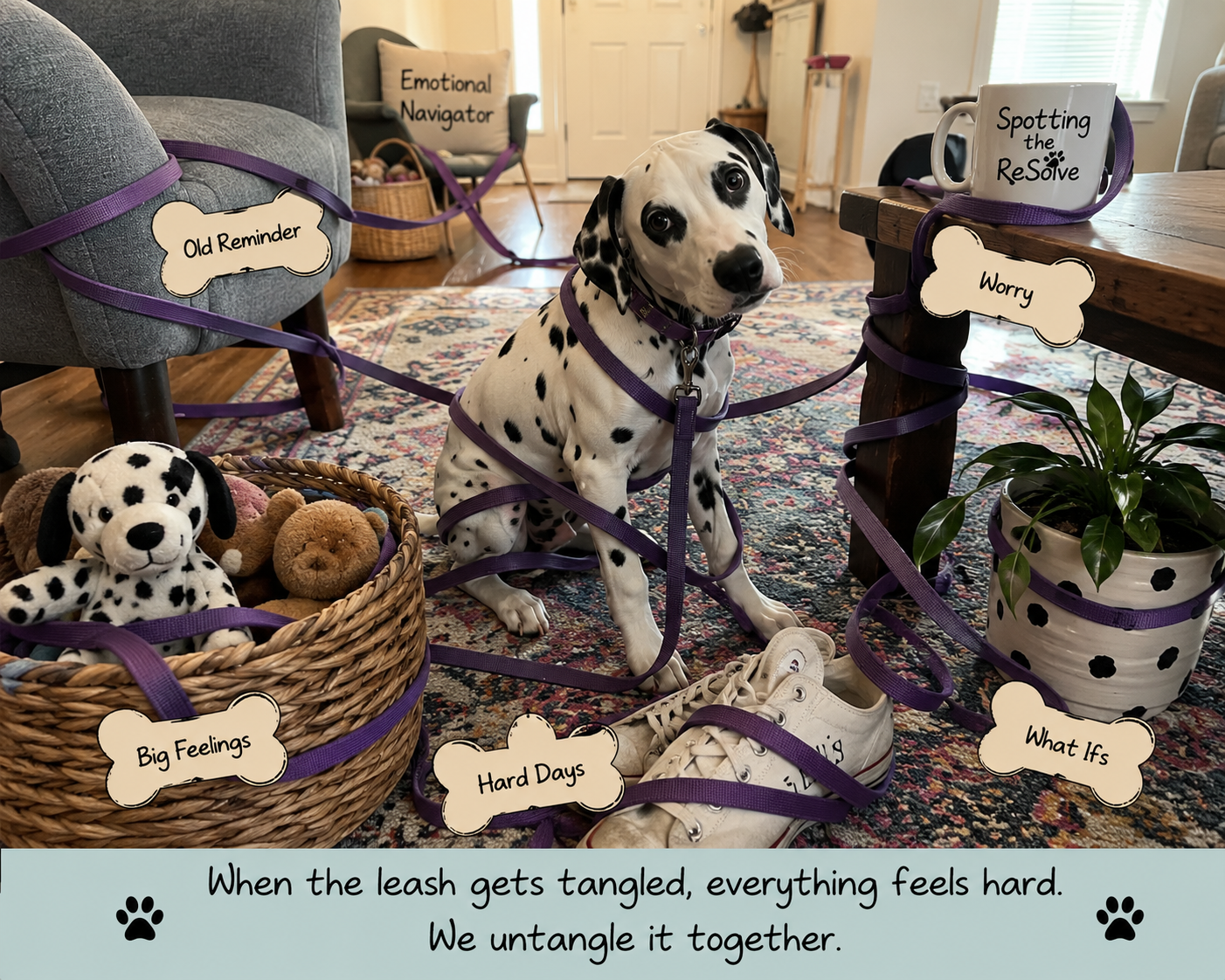
Think of It Like Untangling a Leash
Picture taking your Dalmatian for a walk.
Somehow?
The leash wraps around every tree, bench, mailbox, and your own feet.
You could keep pulling harder...
But that usually makes the knot tighter.
Instead...
You slowly work one loop at a time.
Eventually...
Nothing changed about the leash.
But now it works the way it was meant to.
EMDR works a lot like that.
We're not erasing memories.
We're gently helping your brain untangle them.
Do We Have to Talk About Every Detail?
This is one of the questions parents ask me most.
The answer is...
Not necessarily.
Unlike many traditional therapies, EMDR doesn't require someone to tell every detail of what happened.
For many children—and even adults—that feels like a huge relief.
Instead, we work at a pace that feels safe while helping the brain do the healing work it already knows how to do.
What Does EMDR Look Like With Children?
Here's where my play therapist heart gets really excited.
Children don't always process experiences through words.
They process through play.
Movement.
Stories.
Drawing.
Imagination.
Stuffed animals.
Games.
That's why EMDR with children rarely looks like someone lying on a couch talking for an hour.
Instead, therapy may include:
• play
• storytelling
• art
• movement
• sand tray
• puppets
• stuffed animals
• imagination
• tapping
• gentle bilateral activities
We're following your child's lead while helping their brain notice that today is different from yesterday.
Parents Often Tell Me...
"My child smiles more."
"They aren't melting down over every little thing anymore."
"They're sleeping."
"They aren't so afraid."
"They seem lighter."
Not because we changed who they are.
Because their Emotional Navigator isn't getting stuck looking at the old map anymore.
Is EMDR Right for My Family?
EMDR can be incredibly helpful for children, teens, and adults experiencing:
Trauma
Anxiety
Panic
PTSD
Grief and loss
Medical trauma
Adoption or foster care transitions
Attachment wounds
Childhood abuse or neglect
Divorce or family changes
Bullying
Phobias
Distressing memories
Big emotions that seem to come out of nowhere
Every person is different.
Every story is different.
We'll never rush into EMDR.
First, we build safety.
We help your child (or you) feel confident using calming tools.
We make sure your Emotional Navigator has everything needed for the journey before we begin exploring the harder spots.
Healing isn't about forcing the brain to forget.
It's about helping the brain finally recognize...
"That was then."
"This is now."
And that's often where hope begins.
You Don't Have to Figure This Out Alone
If you're wondering whether EMDR might be the next right step for you or your child, I'd love to help you sort through the clues.
We'll talk about what's been happening, what's already been tried, and whether EMDR feels like the best fit for your family's journey.
Because around here...
We don't just treat behaviors.
We spot the clues.
We help Emotional Navigators find their way home.
And we restore joy—one spot at a time.
Ready to Help Your Family Find Its Way Forward?
If you're reading this and thinking,
"This sounds like my child..."
or
"This sounds like me..."
I'd love to help you sort through the clues.
At Spotting the Resolve, we provide EMDR therapy in Longview, Texas for children, teens, and adults who are navigating trauma, anxiety, overwhelming emotions, grief, attachment wounds, and life's unexpected storms.
You don't have to know whether EMDR is the right fit before reaching out—that's what we're here for. We'll spend time getting to know your story, answering your questions, and creating a plan that feels safe, personalized, and supportive.
Whether your Emotional Navigator has been feeling stuck for years or you've just started noticing that something doesn't feel quite right, healing is possible.
You don't have to untangle the leash alone.
📍 Spotting the Resolve
Longview, Texas
🐾 Serving children, teens, adults, and families throughout Longview, Hallsville, White Oak, Gilmer, Kilgore, Marshall, Tyler, and the surrounding East Texas communities.
Ready to take the next step?
Reach out today to schedule your first appointment or ask any questions. We'd be honored to walk alongside you as your family learns to spot the clues, untangle the hard spots, and restore joy—one spot at a time.
Because every family deserves a place where they feel seen, safe, and understood.