Behavior Is Still Communication… Even After Age 10
Behavior Is Still Communication… Even After Age 10
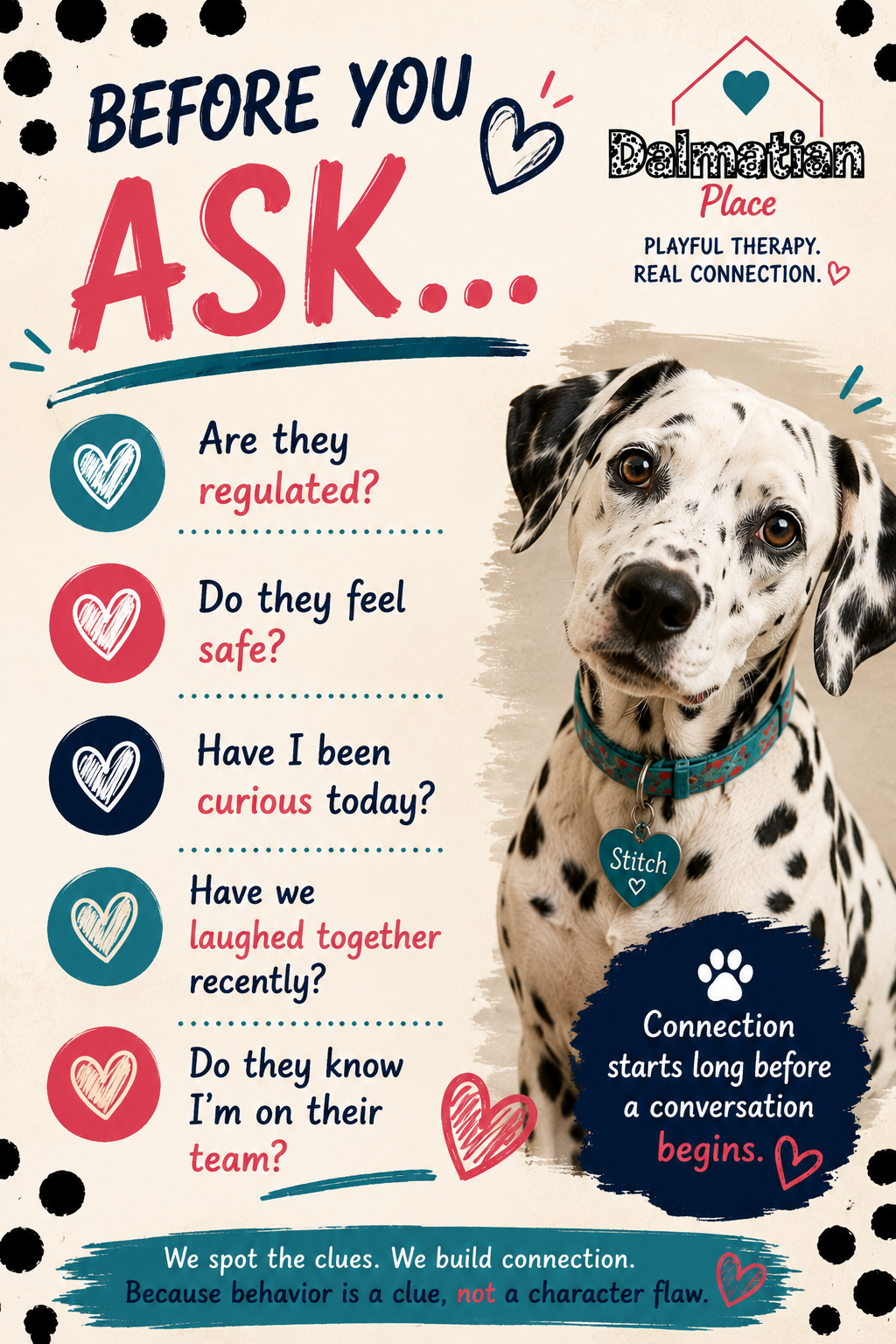
"The clues don't disappear as children get older. They just become a little harder to spot."
If you've been around Dalmatian Place for very long, you've probably heard me say:
Behavior is a clue, not a character flaw.
It's one of the beliefs that guides everything I do as a therapist.
But here's something I think parents need to hear:

That doesn't stop being true once children get older.
Somewhere along the way, we start expecting older kids and teenagers to simply tell us what's wrong.
We say things like:
"Just use your words."
"Tell me what's going on."
"Why are you acting like this?"
And when all we get back is...
"I don't know."
"I'm fine."
"Leave me alone."
...it can feel like they've stopped communicating with us.
But they haven't.
They've simply found different ways to tell their story.
Spot the Clues 👀
Older children don't usually throw themselves on the grocery store floor anymore.
Instead, their behavior might look like:
🐾 Spending all their time alone in their room
🐾 Becoming irritable over small things
🐾 Being overly responsible or perfectionistic
🐾 Suddenly refusing activities they used to enjoy
🐾 Becoming anxious about things that never bothered them before
🐾 Snapping at siblings
🐾 Shutting down when emotions get big
🐾 Saying, "I don't care," when they really care deeply
These behaviors can be frustrating.
But before we ask,
"How do I make this stop?"
I wonder if we could ask a different question.
What might this behavior be trying to tell me?
Sometimes the Loudest Behaviors Are Covering the Quietest Feelings
Children don't always have words for things like:
"I'm overwhelmed."
"I don't feel safe."
"I'm scared I'll disappoint you."
"I don't know why my heart won't stop racing."
"I miss when things felt different."
"I feel left out."
"I don't know how to ask for help."
Instead...
Their nervous system speaks first.
Their behavior becomes the message.
That doesn't mean every behavior is acceptable.
Boundaries are still important.
Consequences still have a place.
But connection almost always comes before correction.
Because children who feel understood are much more likely to become children who can understand themselves.
The Brain Remembers What the Mouth Can't Explain
One of the reasons I love working with trauma and anxiety is that sometimes children truly don't know why they're reacting the way they are.
Our brains are incredible.
They are designed to protect us.
Sometimes, after difficult experiences, the brain keeps sounding an alarm long after the danger has passed.
That can look like:
❤️ Big emotions that seem to come out of nowhere
❤️ Worry that doesn't make sense
❤️ Difficulty sleeping
❤️ Trouble concentrating
❤️ Feeling "stuck"
It's not because children are deliberately being difficult.
Often, it's because their nervous system is working overtime to keep them safe.
This is one of the many reasons I use approaches likeEMDR therapyalongside play therapy with children, teens, and adults. Healing isn't always about finding the perfect words. Sometimes it's about helping the brain and body realize they're finally safe.
I'll be sharing more about EMDR in the coming weeks because it's one of the most misunderstood—and most effective—tools I use with families.
Why This Matters So Much to Me
If I'm honest...
I don't write these movie nights because I have everything figured out.
I write them because I'm living this too.
I'm a mom of five amazing kids. Two have already grown up and left the nest, and three are still keeping me on my toes every single day.
So when I tell you that connection is hard sometimes...
I mean it.
I've had the one-word answers.
I've had the slammed doors.
I've had moments when I wondered whether I was saying the right thing or if I should say anything at all.
I've had seasons when life felt so busy that everyone was simply surviving the week.
That's one of the reasons Dalmatian Place exists.
Not because I believe families need to be perfect.
Because I believe families deserve places where they can breathe.
I've learned something over the years—both as a therapist and as a mom:
The little moments matter more than we think.
The conversation in the car.
Laughing over dinner.
Watching a movie together.
The five extra minutes before bed.
Those moments don't always look important while they're happening.
But they become the memories our children carry.
I'm not inviting you into a perfect family. I'm inviting you into a family that's still learning that connection grows in ordinary moments. That's the kind of family I'm raising too.

I Don't Want to Give You More to Do.
I know you're already carrying enough.
You're juggling work.
School.
Activities.
Laundry.
Dinner.
Homework.
The mental load of remembering everyone's everything.
The last thing you need is another parenting expert handing you a list of twenty things you're supposed to do better.
That's never been my heart.
I want to make connection feel possible again.
Sometimes that means planning dinner for you.
Sometimes it means giving you five conversation starters.
Sometimes it means helping you understand the behavior you've been trying so hard to "fix."
Because underneath almost every behavior...
...there's a child asking,
"Am I safe?"
"Do I belong?"
"Will you stay with me?"
That's Why I Created Family Dinner & a Movie.
Not because I think one movie changes a family.
But because one evening can.
One laugh.
One honest conversation.
One memory.
One moment where someone feels seen.
Those little moments have a way of becoming something much bigger.
That's what I'm hoping these movie nights become for your family.
Not another thing on your calendar.
A tradition.
And If You Need More Than a Movie Night...
Sometimes families need a little extra support.
Not because anyone has failed.
Not because anyone is broken.
Just because parenting is hard, relationships get messy, and all of us need someone in our corner sometimes.
If that's where you are today, I'd love to walk alongside your family.
At Dalmatian Place, we don't just look at behavior.
We spot the clues.
We slow down.
We get curious together.
And we help children, teens, and parents reconnect in ways that feel safe, playful, and genuine.
Because there really is a gentler way.
And I'd love to help you find it.
Here's My Challenge for You This Week
The next time your child has a big reaction…
Pause for just a moment.
Instead of asking:
"What's wrong with my child?"
Try asking:
"What clue might I be missing?"
You don't have to have all the answers.
You just have to stay curious.
Because curiosity opens doors that criticism never will.
Keep Spotting the Clues ❤️
If this week's blog resonated with you, I think you'll love our new Family Dinner & a Movie with a Side Dish of Therapyseries.
Our first movie night features Lilo & Stitch, with easy dinner ideas, conversation starters, printable activities, and playful ways to help your family build connection—right from your own living room.
It's completely free because I believe some of the most meaningful therapy moments don't always happen in my office.
Sometimes they happen around your dinner table.
And if you're finding that your child's behavior keeps leaving you wondering what they're trying to tell you, I'd love to help.
At Dalmatian Place in Longview, Texas, I work with children, teens, adults, and families using playful, trauma-informed approaches—including Play Therapy and EMDR—to help uncover what lies beneath the behavior.
Because every child deserves someone willing to look beyond the behavior...
...and spot the clues.
🐾 Stitch Spotted This: "Sometimes teenagers say the most with a shrug."
Frequently Asked Questions
Why won't my teenager talk to me anymore?
As teens grow, they naturally seek more independence. Pulling away doesn't always mean they don't want a relationship—it often means they're learning how to navigate emotions in new ways. Creating emotional safety instead of pressuring them to talk often leads to more meaningful conversations over time.
How can I get my teenager to open up?
Focus less on asking lots of questions and more on spending relaxed, pressure-free time together. Watching a movie, taking a drive, cooking dinner, or sharing an activity often creates opportunities for conversation that feel more natural.
Is it normal for teenagers to pull away from their parents?
Yes. Some distance is a typical part of adolescent development. However, if your teen becomes consistently withdrawn, isolated, angry, or overwhelmed, it may be helpful to seek additional support.
When should I consider therapy for my teenager?
Therapy may be beneficial if your teen is experiencing anxiety, depression, emotional outbursts, school avoidance, trauma, friendship difficulties, or if family communication feels stuck in constant conflict. Early support can strengthen relationships before problems become more overwhelming.
Do you offer therapy for teens in Longview, Texas?
Yes. At Dalmatian Place, we provide private-pay therapy for children, teens, parents, and families in Longview and throughout East Texas. We use trauma-informed, attachment-focused approaches to help families build stronger relationships and understand the "why" beneath behavior.
Can parents participate in therapy?
Absolutely. Parents are an essential part of the healing process. Depending on your family's goals, therapy may include parent coaching, family sessions, or individual support for your teen.
Still spotting clues, but not sure what they're telling you?
You don't have to figure it out alone.
At Dalmatian Place, we help families discover what's underneath the behavior so they can reconnect with confidence, compassion, and hope.
Whether your child is five or fifteen, connection is still possible.
If you're ready to stop guessing and start understanding, I'd love to walk alongside your family.
📍 Dalmatian Place
Family Therapy in Longview, Texas
📞 (903) 309-3656
✉️ Jessica@spottingtheresolve.com
Looking for Teen Therapy in Longview, Texas?
Dalmatian Place provides private-pay therapy for children, teens, and families in Longview, Texas. We specialize in trauma-informed, neurodiversity-affirming therapy that helps families strengthen connection, improve communication, and better understand the clues behind behavior.
Whether your teen is struggling with anxiety, trauma, emotional regulation, or simply feels disconnected, we're here to help your family reconnect.
📍 Serving Longview, Hallsville, White Oak, Kilgore, Gilmer, Marshall, Gladewater, and surrounding East Texas communities.
Ready to Learn More?
📍 Dalmatian Place | Family Therapy in Longview, Texas
📞 (903) 309-3656
✉️ Jessica@spottingtheresolve.com
🐾 Behavior is a clue, not a character flaw.
