
AutPlay Therapy for Neurodivergent Children in Longview, Texas

When Your Child’s Behavior Feels Like a Puzzle, We Start by Spotting the Clues:
Maybe your child has always seemed a little…different.
They feel everything deeply. They fall apart over a change that seems tiny. Socks are suddenly unbearable. School takes every ounce of energy they have. They can talk for hours about something they love, but completely shut down when you ask what is wrong.
Perhaps you have heard words like autistic spectrum, ADHD, sensory differences, gifted, twice-exceptional, highly sensitive, demand avoidant, anxious, rigid, oppositional, or “just too much.”
Or maybe you do not have a name for it yet.
You simply know that the usual parenting advice is not working, and everyone, including you, is becoming exhausted.
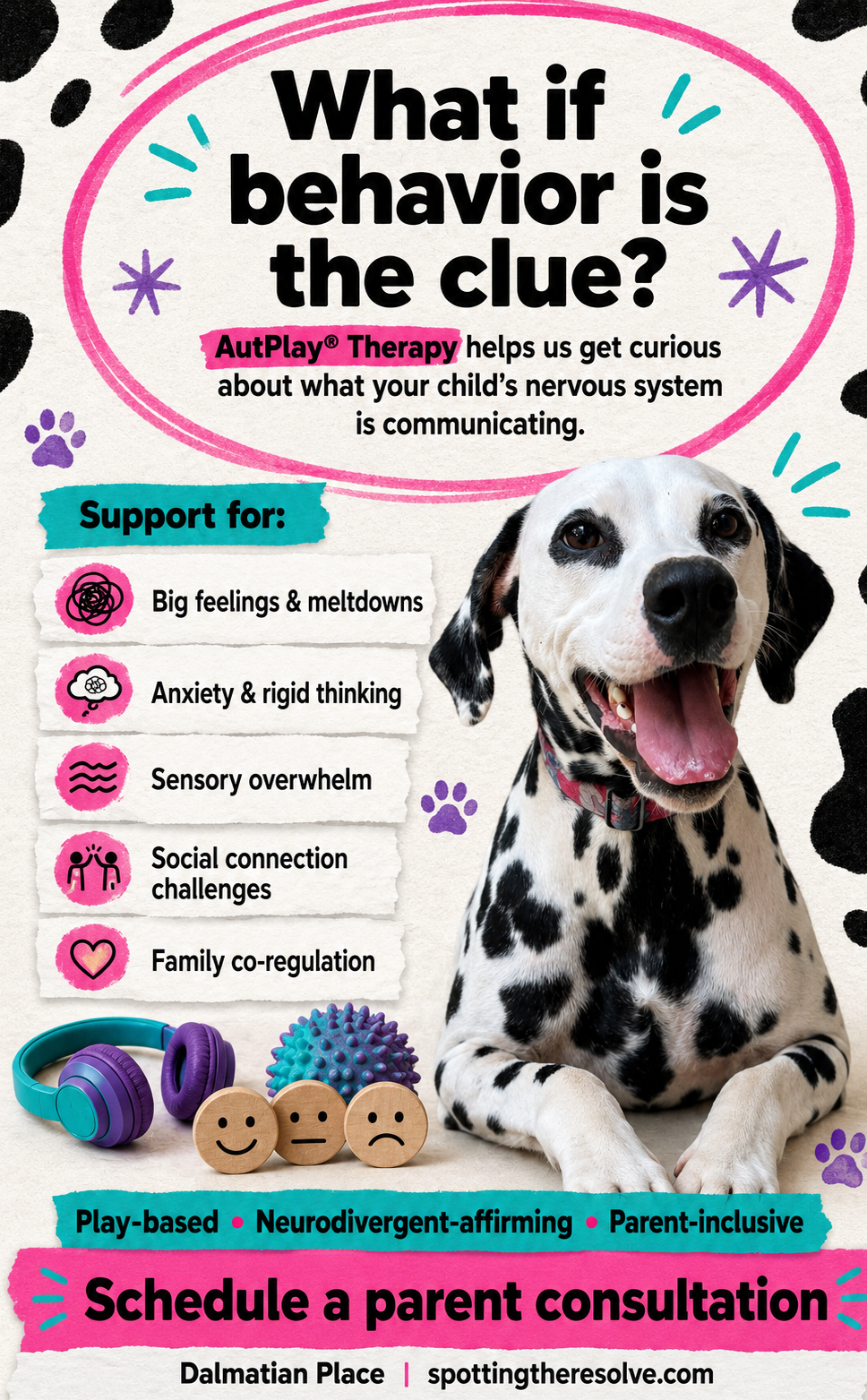
At Dalmatian Place, we believe behavior is a clue, not a character flaw. AutPlay® Therapy helps us look beneath those baffling behaviors so we can better understand what your child’s nervous system may be trying to communicate.
Your child is not a problem to solve.
They are a whole person who deserves to be understood.
What Is AutPlay Therapy?
AutPlay is a neurodiversity-affirming framework for using child and play therapy to support neurodivergent children, adolescents, and their families.
That includes children who are:
Autistic
ADHD
Gifted or twice-exceptional
Experiencing sensory differences
Living with learning or developmental differences
Struggling with anxiety, trauma, or emotional regulation
Still waiting for answers or an evaluation
AutPlay does not begin by asking, “How do we make this child act more typical?”
Instead, we become curious:
What is happening underneath this behavior?
Is your child overwhelmed, confused, anxious, disconnected, or sensory overloaded?
What helps this particular nervous system feel safe?
How does your child naturally communicate, connect, and play?
Which skills would genuinely support your child—not simply make adults more comfortable?
We spot the clues, identify your child’s strengths and needs, and create support that fits the child standing in front of us.
Your Child Does Not Need to Become Less Themselves
Neurodivergent-affirming therapy does not treat your child’s identity as an illness to cure.
We are not here to force eye contact, eliminate harmless stimming, take away special interests, demand neurotypical play, or teach your child to hide distress more successfully.
We want children to develop skills that help them experience greater safety, connection, autonomy, self-understanding, and emotional well-being.
That may include helping your child:
Recognize and communicate emotions
Understand their individual sensory needs
Develop regulation and co-regulation strategies
Navigate anxiety, fear, transitions, and unexpected changes
Strengthen connection with parents and caregivers
Build self-worth and an affirming understanding of their identity
Practice self-advocacy
Navigate social situations without being taught to perform or mask
Process trauma through developmentally appropriate play
Discover ways to ask for space, help, movement, information, or connection
The goal is not a more convenient child.
The goal is for a child to feel safer being fully themselves.
It ALWAYS includes parents, and support people as appropriate, and supporting those supporters in the best way to support and meet that child’s needs. My goal is to educate the entire system on how best to work with this child and meet their needs.
The “Baffling Behaviors” May Be Clues
Neurodivergent distress can wear a lot of different spots.
It might look like:
Melting down after school
Exploding over a seemingly small request
Refusing school, homework, bathing, dressing, or transitions
Shutting down and saying, “I don’t know”
Becoming controlling when plans change
Hiding in a bedroom or preferred activity for hours
Constantly seeking reassurance
Struggling with friendships or feeling repeatedly misunderstood
Experiencing headaches, stomachaches, or exhaustion
Becoming aggressive when overwhelmed
Appearing defiant when a demand feels impossible
Holding everything together in public and unraveling at home
Masking so successfully that no one outside the family sees the struggle
These behaviors still require boundaries, safety, and support. But consequences alone cannot teach a dysregulated nervous system to feel safe.
Before we ask, “How do we stop this?” we ask:
What happened, what is needed, and what is this child trying to communicate?
That shift—from judgment to curiosity—is where we begin spotting the resolve.
Why Use Play Therapy?
Children do not always have the words to explain sensory overwhelm, social confusion, anxiety, rejection, trauma, masking, or the pressure they feel to keep up.
But they can often show us through play.
Play gives children space to communicate, experiment, practice, create, process, connect, and develop new ways of responding without turning every session into a face-to-face interrogation.
At Dalmatian Place, we honor your child’s actual style of play. That might involve movement, animals, art, games, building, sensory materials, imagination, technology, special interests, or carefully observing before joining.
There is no single “correct” way for a neurodivergent child to play.
Their interests are not distractions from therapy. They can become doorways into safety, communication, and connection.
Parents Are Part of the Pack
AutPlay Therapy is not about dropping your child off to be “fixed” while you wait in the lobby.
Parents and caregivers are important partners in the therapeutic process.
Together, we may explore:
What tends to happen before a meltdown or shutdown
How your child signals that their regulation is slipping
Which expectations or environments create unnecessary distress
What helps your child return to safety
How to offer boundaries without adding shame
Ways to strengthen connection after difficult moments
Practical supports that can be used at home, school, and in the community
You deserve support too.
Parenting a child whose needs are misunderstood can leave you second-guessing every decision. Our work is not about blaming parents. It is about helping the whole family develop a clearer map.
What AutPlay Therapy at Dalmatian Place May Address
AutPlay-informed therapy may support neurodivergent children and families experiencing:
Emotional dysregulation
Meltdowns and shutdowns
Anxiety and fears
School anxiety or school refusal
Sensory overwhelm
Social navigation difficulties
Low self-worth
Masking and burnout
Executive-functioning challenges
Trauma responses
Parent-child strain
Difficulty identifying or communicating needs
Challenges with change and transitions
Friendship stress or rejection
Identity development and self-advocacy
Therapy is individualized. We do not hand every child the same worksheet, regulation strategy, or social script and expect it to fit.
Different nervous systems need different kinds of support.
What Makes Dalmatian Place Different?
Dalmatian Place is not an adult counseling office with a basket of toys tucked into the corner.
It is a child-designed therapeutic space created specifically for the ways children communicate, connect, and heal.
Jessica Anderson, MS, LPC, is an AutPlay-certified, TraumaPlay-certified therapist who integrates play, trauma-informed care, neurodivergent-affirming practices, parent support, and animal-assisted experiences.
Here, we spot clues NOT flaws.
We make room for movement, interests, sensory needs, uncertainty, big feelings, quiet moments, and the wonderfully uneven spots that make every child their own person.
Does My Child Need an Autism or ADHD Diagnosis?
Not necessarily.
Some families arrive with a diagnosis and a folder full of evaluations. Others arrive saying:
“I don’t know what is going on. I just know my child is struggling.”
You do not have to solve the entire puzzle before asking for support. A parent consultation can help us discuss what you are seeing, whether Dalmatian Place may be a good fit, and what next step makes sense for your family.
Is AutPlay the Same as Teaching Social Skills?
AutPlay can address social navigation, but the goal is not to train a child to imitate neurotypical behavior or ignore their own boundaries.
Affirming social support may help a child understand situations, recognize their needs, communicate preferences, repair misunderstandings, advocate for themselves, and build relationships that feel safe and authentic.
Will Therapy Stop the Meltdowns?
No ethical therapist can promise that a child will never become overwhelmed again.
Therapy may help your family better understand triggers, recognize earlier signs of dysregulation, create effective supports, strengthen co-regulation, and develop safer ways to communicate distress.
The goal is not to punish a nervous system for becoming overwhelmed. It is to understand it and expand the support surrounding it.
Your Child’s Differences Are Not Character Flaws
You may have spent months—or years—hearing everything your child needs to stop doing.
At Dalmatian Place, we also want to know:
What lights them up?
Where do they feel most like themselves?
What are they trying so hard to communicate?
What helps their body feel safe?
Which adults truly understand them?
What strengths have been hiding beneath the struggle?
Your child’s spots do not need to match anyone else’s.
Let’s understand the child you have, support the nervous system beneath the behavior, and restore joy—one spot at a time.
Schedule an AutPlay Parent Consultation
If you are searching for AutPlay Therapy, autism-informed play therapy, ADHD support, help with meltdowns, neurodivergent-affirming counseling, or a child therapist in Longview, Texas, Dalmatian Place may be the next right step.
Schedule a parent consultation to tell us what you are noticing and explore whether our approach fits your child and family.
Fill out the Contact form to schedule a FREE 15-minute Phone consultation or begin the process to start your intake for care at Dalmatian Place!
Neurodivergent-affirming play therapy, trauma therapy, parent support, and animal-assisted therapeutic experiences in East Texas.
Get In Touch
If you're interested in scheduling an AutPlay consultation or Intake, fill out the following form.