Why Your Child Can't "Just Move On"(And Why That Doesn't Mean You're Doing Anything Wrong)
If you've ever found yourself thinking...
"We've talked about this a hundred times."
"That happened years ago."
"Why can't they just let it go?"
Friend, you're not alone AND more importantly:
your child probably isn't choosing to stay stuck.
At Dalmatian Place, we say something often:
Behavior is a clue, not a character flaw.
Sometimes the biggest clue isn't what your child is doing...
It's what their brain is still trying to protect them from.

🐾 Stitch Taught Me Something About Brains
If you've followed us for very long, you've probably met Stitch—our Dalmatian, Chief Spotter of Clues, and unofficial office greeter.
One thing about Stitch?
He notices everything.
A squirrel.
A rabbit.
A leaf blowing across the yard.
A new smell on yesterday's walking trail.
He's always spotting something.
Usually he sniffs it…
Decides it's safe…
And keeps walking.
But every once in a while...
He finds something that makes him stop.
Maybe another dog barked unexpectedly.
Maybe a loud truck came around the corner.
Maybe fireworks exploded overhead.
The next walk?
He notices every sound.
Every movement.
Every shadow.
Not because he's stubborn.
Because his brain is trying to keep him safe.
Children's brains work the very same way.
Your Child Isn't Giving You a Hard Time...
They Might Be Having a Hard Time.
When something overwhelming happens...
our brains don't always get the chance to file that memory away.
Instead...
It gets left sitting out on the kitchen counter.
Every day.
Every reminder.
Every smell.
Every sound.
Every similar situation...
Your brain trips over it all over again.
That's why a child who was bitten by one dog suddenly becomes afraid of every dog.
Why a child who experienced bullying panics before school.
Why an adult who grew up walking on eggshells still feels anxious decades later.
The story isn't over in the nervous system.
It's still trying to protect them.
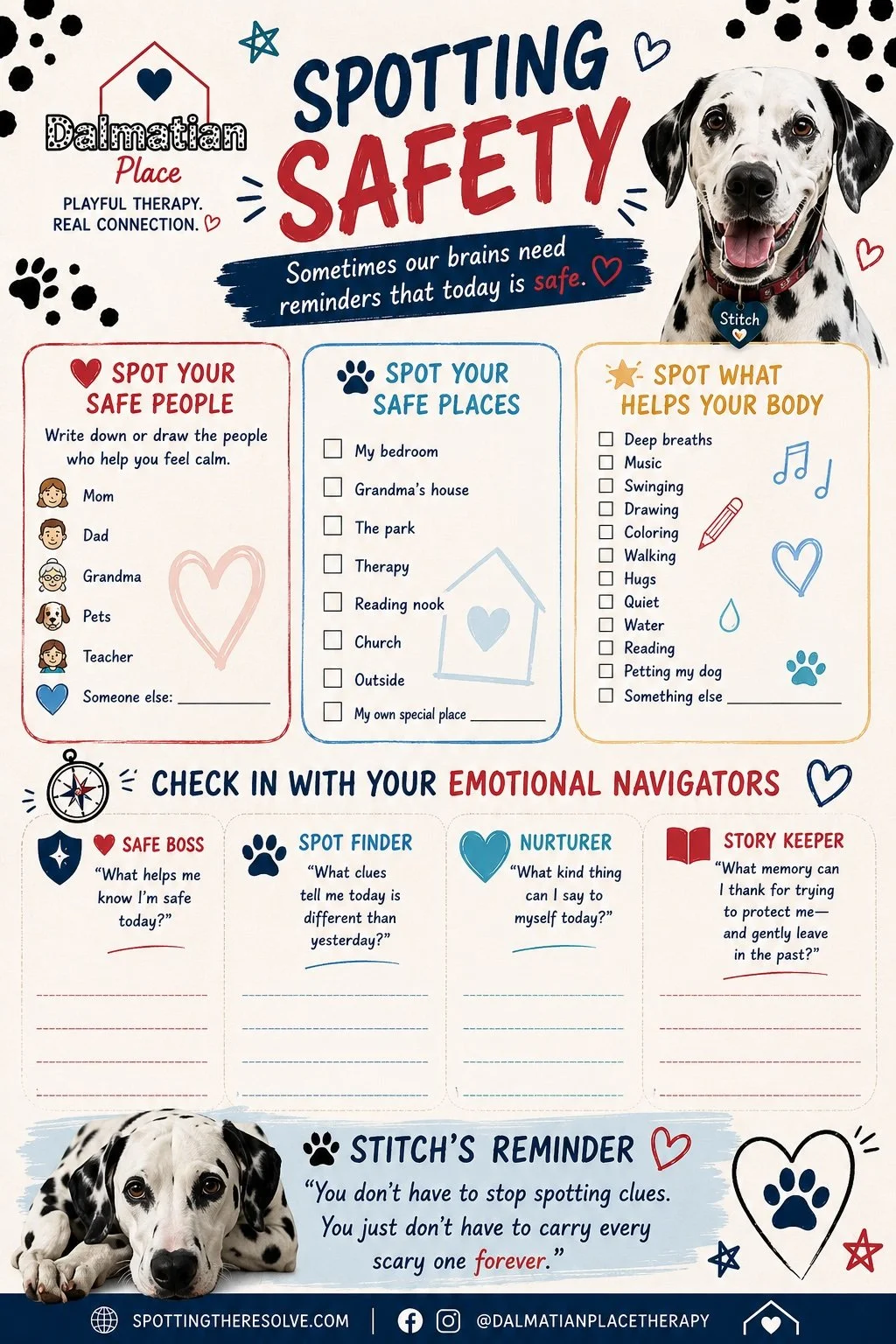
🧭 Meet Your Emotional Navigators
One of the ways we understand healing at Dalmatian Place is through our Emotional Navigator Framework.
Instead of seeing behaviors as "good" or "bad," we get curious about what each part of us is trying to communicate.
❤️ The Safe Boss
The Safe Boss is always scanning.
"Are we okay?"
"Is this person safe?"
"Do I need to protect us?"
Sometimes after trauma...
The Safe Boss starts seeing danger everywhere.
Even when we're finally safe.
🐾 The Spot Finder
Our Spot Finder notices everything.
Tone of voice.
Facial expressions.
Body language.
Changes in routine.
Tiny clues that other people never even notice.
When we've lived through hard things...
our Spot Finder becomes incredibly good at finding danger.
The problem?
Sometimes it keeps spotting danger that isn't actually there anymore.
🤍 The Nurturer
The Nurturer reminds us:
"You don't have to do this alone."
Healing happens in safe relationships.
Children don't need perfect parents.
They need parents who are willing to stay close.
📖 The Story Keeper
Every experience becomes part of our story.
But difficult experiences aren't supposed to stay in the "right now" folder forever.
The Story Keeper's job is to gently place those memories where they belong—
in the past.
So they stop interrupting the present.
So...Where Does EMDR Fit?
I think EMDR is often explained in ways that sound intimidating.
Here's how I explain it.
Imagine your brain is a beautifully organized library.
Most memories get placed on the correct shelf.
Easy to find.
Easy to put away.
Trauma?
Trauma gets dropped in the middle of the floor.
Every time you walk through...
You trip over it.
EMDR helps your brain finally pick up that memory...
Understand it...
Process it...
And place it on the shelf where it belongs.
You still remember it.
It just doesn't feel like it's happening all over again.
That's healing.
Hope for Parents
If you're reading this because your child melts down over "small things"...
Or your teen seems anxious all the time...
Or maybe you're the one carrying a story that still feels heavy...
I want you to know something.
There isn't anything wrong with you.
Sometimes your brain is simply doing exactly what it was designed to do—
protect you.
Together, we can help it learn that today is different than yesterday.
From One Mom to Another...
Before I'm a therapist...
I'm a mom.
Five kids.
Two who have already left the nest.
Three who still keep me humble every single day.
I've packed lunches.
Sat through teenage silence.
Wondered if I was getting it right.
Cried behind closed doors.
Celebrated tiny wins that nobody else noticed.
I've lived enough life to know there isn't a perfect way to parent.
There is only a connected way.
I don't sit across from parents because I've read all the books.
I sit with them because I know what it's feels like to desperately want your child to feel safe, confident, and happy—and to wonder if you're missing something.
That's why Dalmatian Place exists.
To help families stop chasing behaviors...
And start spotting the clues underneath them.
Because once we understand the clue...
Healing becomes possible.
🐾 Keep Spotting the Clues
Every behavior tells a story.
Every emotion points toward a need.
Every child deserves someone willing to get curious instead of critical.
And every family deserves hope.
If you're ready to understand what's underneath the behaviors—not just manage them—we'd be honored to walk alongside you.
At Dalmatian Place, we're restoring joy, one spot at a time.
Frequently Asked Questions
How do I know if my child needs EMDR therapy?
Many parents assume trauma has to involve something dramatic, but that's not always true.
Sometimes children need extra support after:
Divorce
Adoption or foster care
Medical procedures
Bullying
A car accident
The loss of someone they love
Anxiety that never seems to turn off
Repeated "big reactions" that don't match the situation
If your child seems stuck in fear, worry, anger, or shutdown—even when life is safer now—it may be because their brain is still trying to protect them.
That's where EMDR can help.
What age can children start EMDR?
One of the things I love most about EMDR is that it can be adapted for children.
At Dalmatian Place, EMDR with children rarely looks like what most adults imagine.
It might involve:
🐾 Play
🐾 Movement
🐾 Stories
🐾 Art
🐾 Stuffed animals
🐾 Games
🐾 Bilateral stimulation that's woven naturally into therapy
Children don't have to sit on a couch and talk for an hour. They process through play, because play is their language.
Does my child have to talk about what happened?
No.
In fact, many children aren't ready—or don't even have the words—to explain their experiences.
One of the beautiful things about EMDR is that healing doesn't always require retelling every detail.
Instead of forcing children to relive painful memories, we help their brains safely organize those experiences so they no longer feel like they're happening right now.
That often feels much safer for children who have experienced trauma.
My child has big meltdowns. Could trauma be part of the reason?
Sometimes.
Not every meltdown is trauma.
But many behaviors parents worry about are actually clues rather than problems.
Children might:
explode over small things
become extremely anxious
avoid school
have nightmares
struggle to separate from parents
become aggressive
seem "too sensitive"
shut down completely
Rather than asking, "What's wrong with my child?" I encourage parents to ask,
"What is this behavior trying to tell us?"
That's the beginning of spotting the clues.
Is EMDR only for PTSD?
No.
EMDR is widely known for treating trauma, but it can also be helpful for children experiencing:
Anxiety
Grief
Attachment wounds
Adoption-related challenges
Medical trauma
Low self-esteem
Panic
Phobias
Performance anxiety
Emotional regulation difficulties
Every child is different, which is why therapy should be individualized rather than one-size-fits-all.
What makes Dalmatian Place different?
I'm not interested in "fixing" kids.
I'm interested in understanding them.
At Dalmatian Place, we use play, relationship, attachment, nervous system regulation, and evidence-based therapies like EMDR to help children—and the adults who love them—make sense of what's underneath the behavior.
Our philosophy is simple:
Behavior is a clue, not a character flaw.
We believe healing happens when children feel safe enough to be known, understood, and connected.
That's why everything we do is centered around helping families slow down, spot the clues, and restore joy—one spot at a time.
How do I know if we're a good fit?
If you've ever found yourself thinking...
"Nothing we've tried seems to work."
"I know my child is a good kid."
"I feel like I'm failing."
"I just want home to feel peaceful again."
…I want you to know you're not alone.
As a therapist—and as a mom of five—I understand both sides of this journey.
I've experienced the exhaustion of trying to help a struggling child while wondering if you're getting it right. I know what it's like to carry the mental load, second-guess your decisions, and wish someone would simply help you understand what's really going on.
That's why I created Dalmatian Place.
Not to hand out parenting scripts or behavior charts, but to walk alongside families as we spot the clues together.
Because when we understand what's underneath the behavior, everything begins to make a little more sense.
And hope starts to return.
Ready to Spot the Clues?
You don't have to figure this out alone.
Whether your child is struggling with anxiety, trauma, emotional outbursts, or simply feeling "stuck," there's a path forward—and it begins with curiosity, connection, and understanding.
If you're ready to learn what's underneath the behavior, I'd love to help.
At Dalmatian Place, Longview’s Family Therapy Center, we're restoring joy, one spot at a time.
👉 Schedule a consultation or learn more at SpottingTheResolve.com
